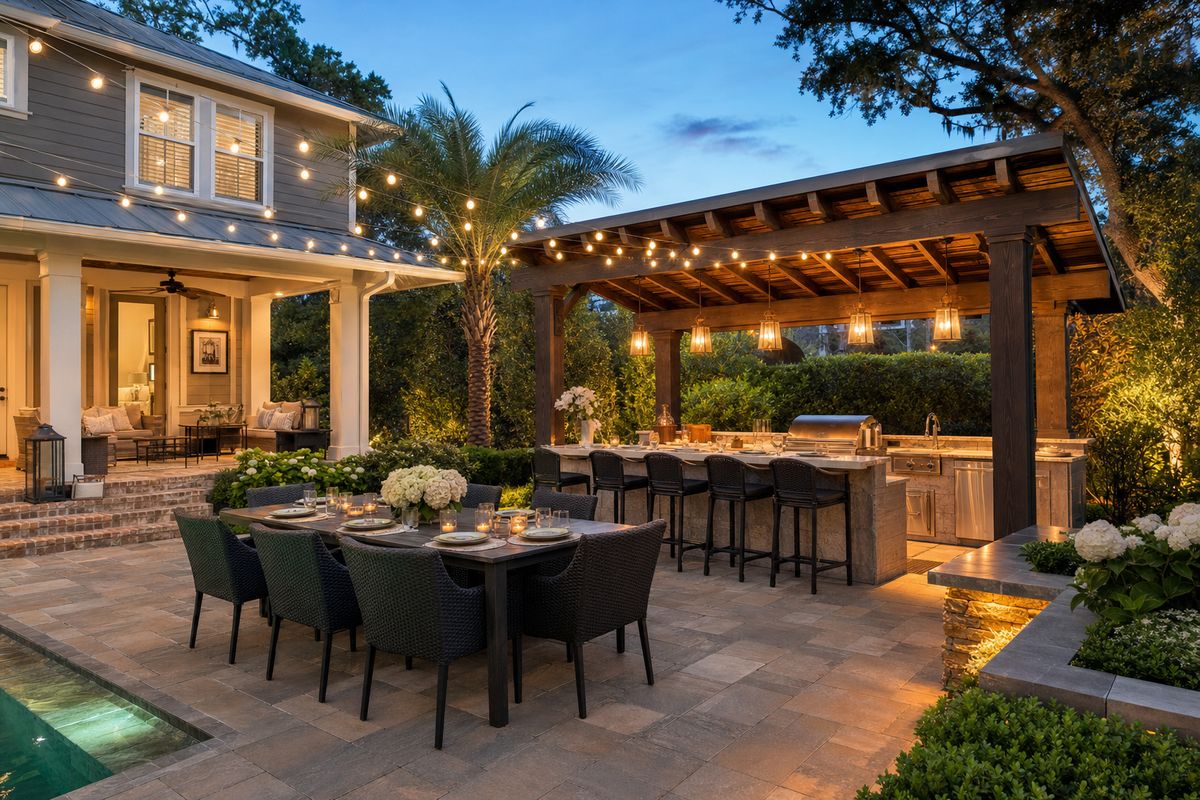
For a Jacksonville outdoor kitchen, sealed granite, quartzite and full-body porcelain are the three surfaces that hold up to Florida sun, salt air and driving rain.
- Quartzite and porcelain handle UV and heat best and need the least upkeep.
- Granite is the value pick, but it has to be sealed on a schedule here.
- Engineered quartz is the one to avoid outdoors: the resin binder yellows in UV and most brands exclude exterior use from the warranty.
Most people have already fallen for a slab in a showroom, and the only question left is whether it will still look like that after five Jacksonville summers. Here is the direct answer: honed or leathered granite is the best all-around outdoor kitchen countertop for Northeast Florida, quartzite is the premium upgrade, and full-body porcelain slab is the smartest choice for a counter with no roof over it. Engineered quartz, the material on most indoor islands, is the one to rule out: its resin binder yellows and chalks under Florida UV, often within two to five summers, and most manufacturers void the warranty on outdoor installs.
We don’t build outdoor kitchens or set kitchen counters; your kitchen company does. We build the space around the kitchen: decks built for outdoor kitchens, paver patios, pergolas, and bar tops on decks. This is general advice for picking a counter. Here is how the five real options behave.
What a countertop has to survive here
- UV. Index 10 to 11 from April into September. That is what destroys resins, pigments and sealers.
- Heat. Highs in the mid 90s with a heat index over 100. A dark slab in open sun gets too hot to lean on.
- Water. About 50 inches of rain a year, and it finds grout joints, unsealed concrete and sloppy seams.
- Salt. Near the ocean or the Intracoastal, salt drift attacks fasteners, adhesives and cheap substructure long before it touches the stone.
- A little cold. A handful of freezing nights most winters. Not enough for real freeze-thaw damage, but enough to pop grout on a saturated tile top.
Five materials that work, and one that does not
| Material | UV fade | Heat | Salt air | Stain risk |
|---|---|---|---|---|
| Granite, honed | None | Excellent | Excellent | Low, sealed |
| Quartzite | None | Excellent | Excellent | Low |
| Porcelain slab | None | Excellent | Excellent | Very low |
| Concrete | Pigments soften | Good | Sealed only | Moderate |
| Porcelain tile | None | Excellent | Good | Grout stains |
| Engineered quartz | Yellows, chalks | Poor | Moot | Low, then fails |
Need the deck, patio or cover for your kitchen? We build the space around it; your kitchen company builds the kitchen. Get a Free Estimate →
Granite
UV stable, indifferent to salt, unbothered by 95-degree heat, and mid-grade slabs are affordable. Skip the polished finish outdoors, since it shows water spots and pollen film; honed or leathered hides both. Plan on sealing it yourself once a year.
Quartzite
Natural stone, denser than most granite, with the pale marble look and none of marble’s problems. It costs more and needs a good fabricator. Ask whether the slab is true quartzite or a soft dolomitic stone sold as quartzite, because the soft ones etch.
Porcelain slab
Our pick for fully exposed counters. Absorption is 0.5% or lower by definition, the color is through-body and will not fade, and light porcelain runs cooler in July than dark stone. The tradeoff is edges, which need a mitered wrap.
Concrete
It looks fantastic and lets you form integral sinks and drainboards. It is also the one material here that changes: pigments soften under UV, citrus and grease stain it once the sealer thins, and hairline cracking is normal.
Tile
Large-format porcelain over cement board is the honest budget answer. The tile is bulletproof. The grout dulls, holds grease and can pop in a saturated joint after a cold snap, so use epoxy grout.
Quartz and quartzite are not the same thing
This trips up more homeowners than anything else we get asked. Quartzite is natural stone quarried out of the ground and is excellent outdoors. Engineered quartz (Silestone, Caesarstone, Cambria) is roughly 90% ground quartz held together with about 10% polymer resin, and that resin is the problem. UV breaks it down, so whites yellow, dark colors fade blotchy and the surface chalks, here within two to five summers. Most major brands exclude outdoor use from their warranty.
Covered or uncovered changes the answer
Under a solid roof the material question gets easier and cheaper. A tile or concrete top on a covered lanai in Riverside will outlive the same top in open sun in a Nocatee backyard by years. With a roof, spend on the structure and the appliances and let the counter be the affordable part. Fully exposed, buy porcelain or light granite and stop there. That call shapes the layout too: see outdoor kitchen ideas for Jacksonville backyards.
Quick picks
- Tightest budget: porcelain tile with epoxy grout. Not a compromise if the kitchen is covered.
- The safe middle: honed granite in a mid tone.
- Fully exposed: porcelain slab, light color, mitered edge.
- Beachside: any of the three. The counter is not your salt problem; your fasteners and hinges are.
- Skip: marble (citrus etches it), soapstone (soft and niche here) and engineered quartz (fails outright).
Color matters more than people expect. A black slab and a light gray slab of the same stone behave completely differently on an August afternoon, the same logic behind decking built for Florida heat and salt air.
Ready to talk it through?
If you are planning a kitchen in Jacksonville, Orange Park, Fleming Island, Nocatee or the Beaches, your kitchen company builds the island and sets the counter. We build what goes around it: a deck framed for the weight, a paver patio or grill pad, a pergola over the cooking area, or a bar top on the deck. Ask about patio and paver construction in Jacksonville if you need a new surface underneath.
Need a deck or patio for your kitchen? We frame it for the weight and can add a pergola or a bar top. Get a Free Estimate →