You want the warmth and grain of real wood — not a plank of plastic pretending to be it. The honest question is whether real wood survives Florida. It does, when it’s the right species fastened the right way. As the wood deck builders Jacksonville homeowners hire for Brazilian Ipe, Western Red Cedar, Cumaru & Tigerwood — plus value-priced pressure-treated pine — we’ll tell you exactly how long each one lasts and what it asks of you. 10-year workmanship warranty. Fixed-price quote in 7 days.
Tell us about your project and we’ll get you a fixed price in 7 days.
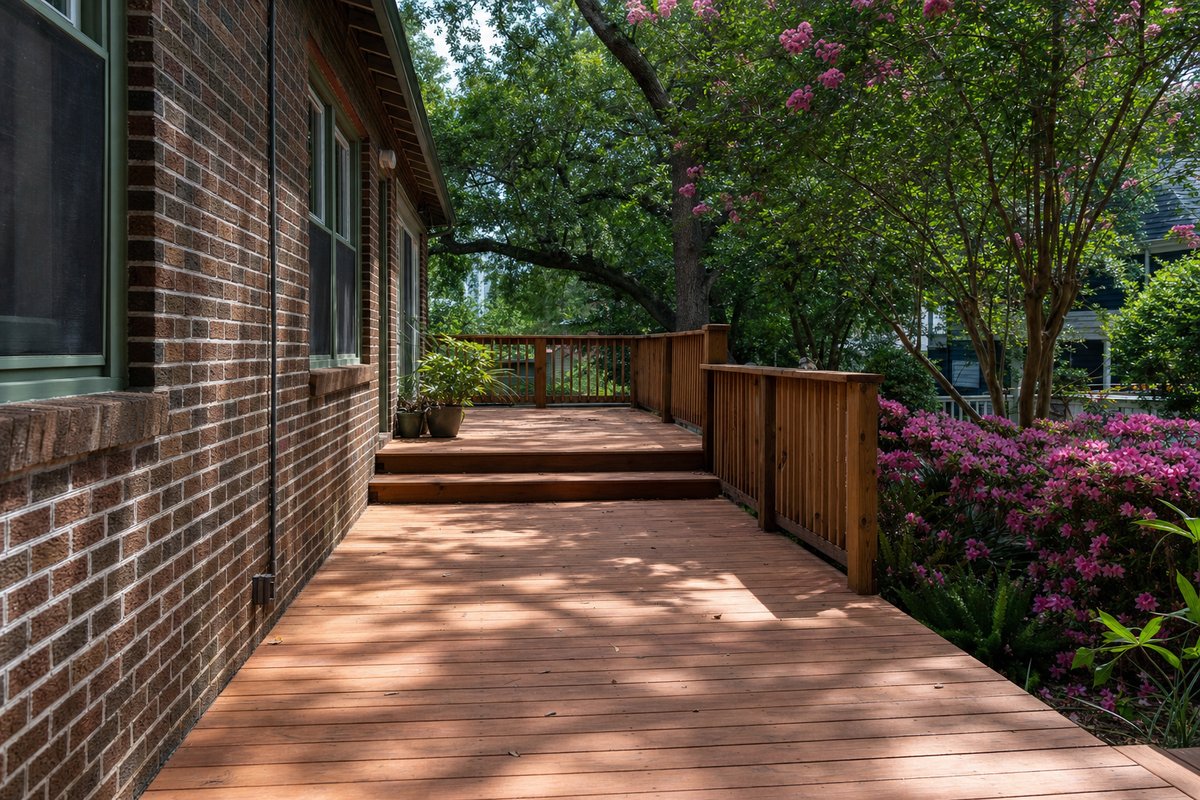
You already know what you want: the depth, the grain, the way real lumber warms in the afternoon sun — the look you simply cannot fake in a plastic plank. The only thing standing between you and that deck is one honest question: how does each species hold up in Florida, and what will it ask of you to stay beautiful? Here’s the straight answer. We build in five real-wood species, and they fall into two camps: dense tropical hardwoods at the top, and pressure-treated Southern pine at the value end. The hardwoods — Brazilian Ipe, Cumaru, Tigerwood, and Western Red Cedar — are naturally rot-resistant down to the core and carry the grain you fell in love with. Pressure-treated pine is the workhorse: the most affordable real-wood deck you can build, and still real wood.
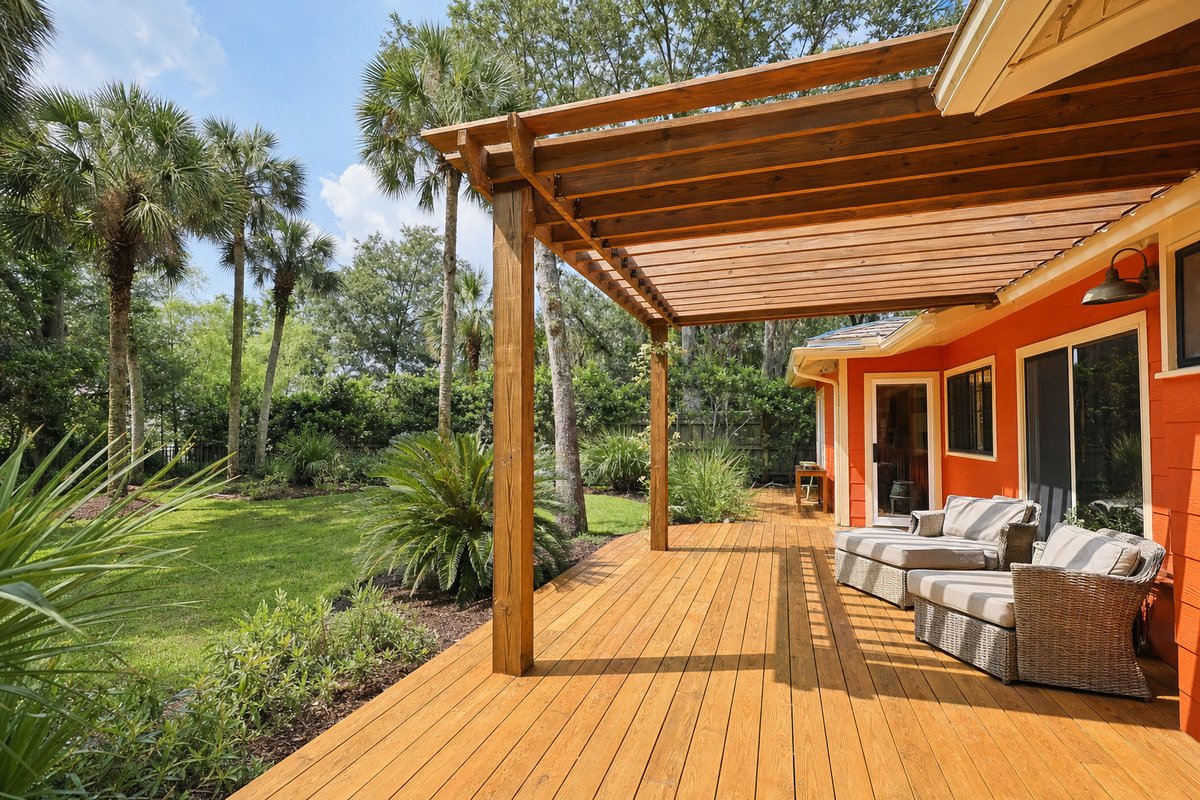
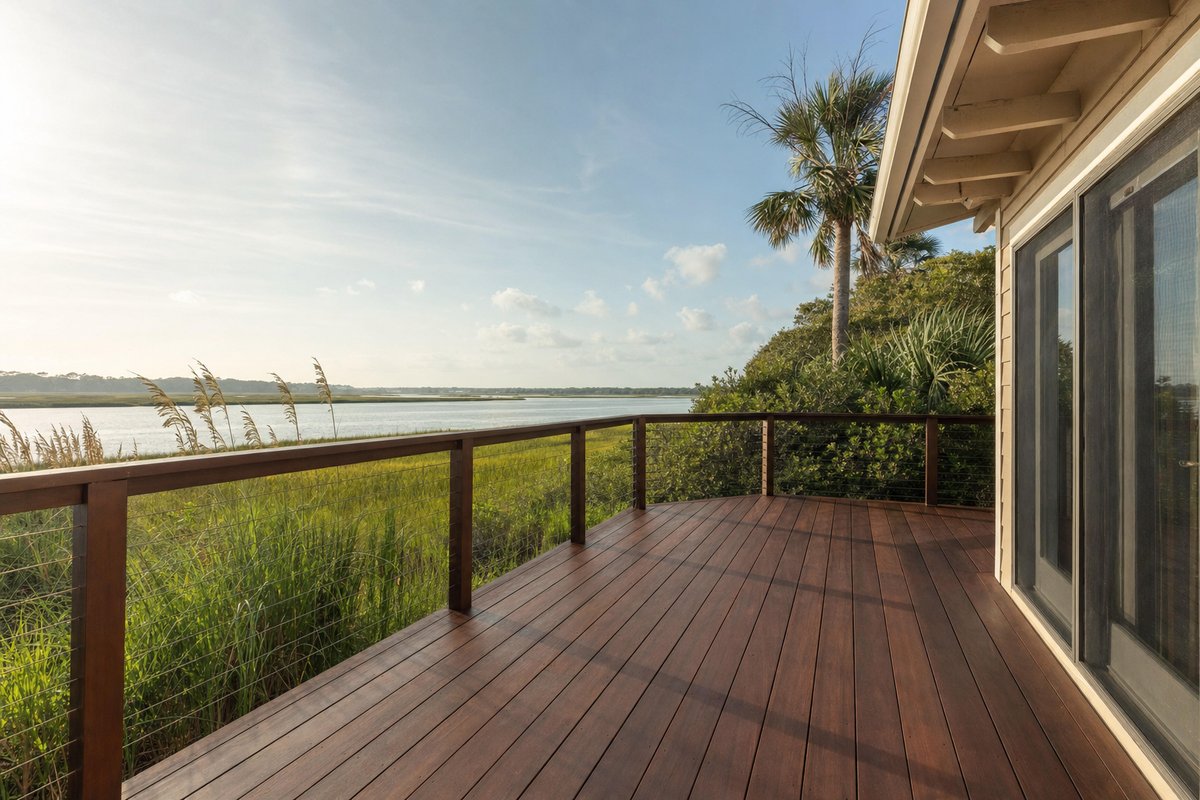
Brazilian Ipe is the flagship, and it’s the answer for the homeowner who wants real wood to outlast everything around it. It’s so dense it sinks in water, carries a Class A fire rating, and oiled on schedule it routinely runs a 40-year deck in this climate. Cumaru (Brazilian Teak) is its near-twin — almost the same density and life at a lower board price. Tigerwood brings dramatic dark-streaked grain when you want the deck itself to be the statement. Western Red Cedar is the warm, aromatic, lightweight classic that stays cool underfoot and ages to a soft silver-gray over its 15-year life — the choice for the covered porch or shaded backyard where you want wood that feels like wood, not a tropical import.
And the maintenance reality, because it’s the part nobody tells you straight: hardwoods want a coat of penetrating oil about once a year to hold their color — skip it and they fade gracefully to silver, no loss of strength. Cedar wants a sealer every two to three years; pine wants a stain coat every one to two. That’s the entire trade for a surface no composite can match. The bones are the same under every board — pressure-treated ground-contact framing tied with hurricane-rated metal connectors, hardwoods pre-drilled and set on marine-grade 316 stainless so they never split and no rust ever bleeds down the face. The difference you pay for is the wood you walk on, not the structure holding it up.
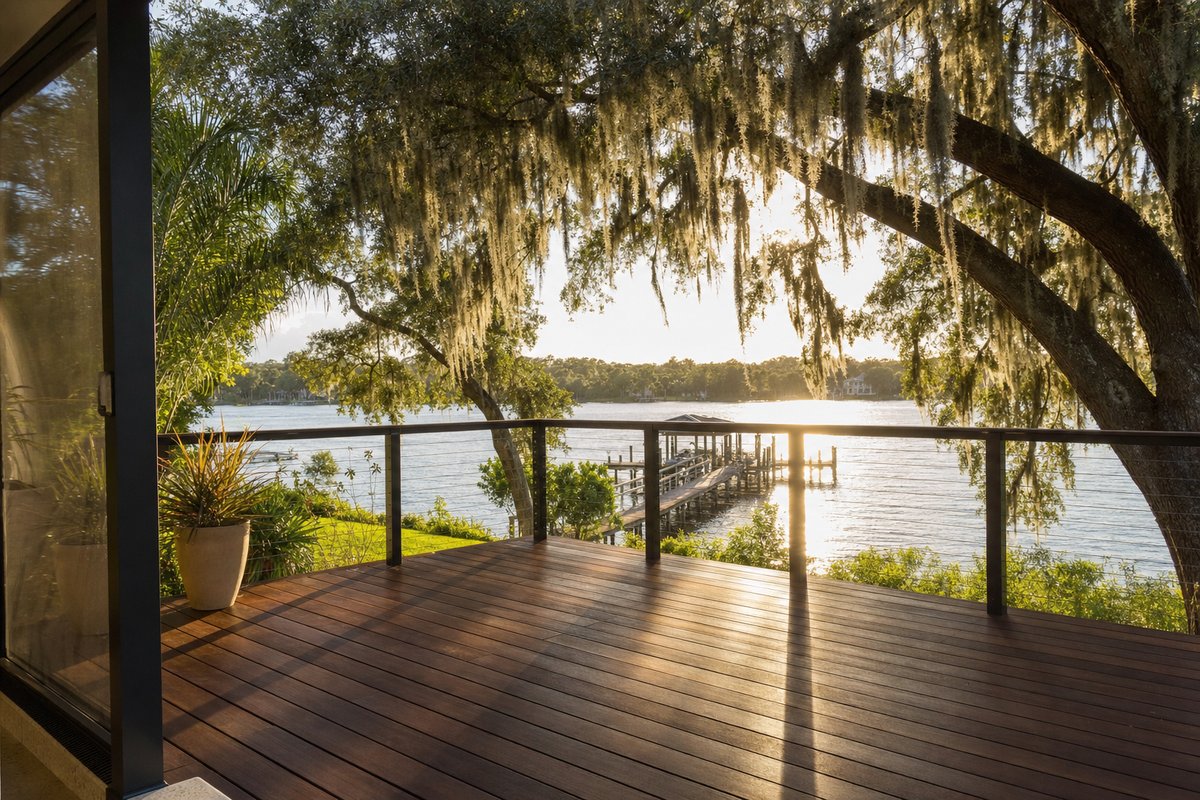
Here’s the fear that’s really driving your search: you’ve seen what Florida does to wood. The graying, the cupping, the soft spot by the back door five years in. So you wonder if loving real wood means signing up for a rebuild. It doesn’t — and a good hardwood deck installer Jacksonville trusts earns their keep proving it. That sad five-year deck almost never failed because it was wood. It failed because it was the wrong board, face-screwed into wet framing with rusting fasteners and never sealed. The afternoon storms, the relentless UV, the salt off the Atlantic, the termite pressure — they punish a careless build and barely touch a careful one. We build pine to last its full 10–15 years and we build Ipe and Cumaru to outlive your mortgage, because the hardwoods are naturally rot- and insect-resistant to the core and shrug off the humidity that destroys lesser lumber.
The bones are where that promise gets real, and they’re identical no matter which wood you fall for. Every deck we frame sits on 24-inch concrete footings sized for hurricane uplift, with ground-contact pressure-treated lumber and hurricane-rated metal connectors — joist hangers, post bases, post caps, and hurricane ties — pulling the whole assembly into one continuous load path. On the coast — Atlantic Beach, Ponte Vedra Beach, Jacksonville Beach, Amelia Island — every fastener becomes marine-grade 316 stainless so salt air can never corrode the connections holding your deck to the house. Inland Duval is engineered to 130 mph wind, oceanfront to 150 mph. None of it is optional, none of it is an upcharge, and all of it is line-itemed in your fixed-price quote — so the natural-wood deck you wanted is also the one that’s still standing after the storm. Want a pergola, an outdoor kitchen, or a covered patio later? The frame is already built to carry it.
Five real-wood decking species — three tropical hardwoods, one cedar, and pressure-treated Southern pine — spanning the value spectrum from a budget pine deck to a 40-year Brazilian Ipe build. Every species gets the same engineered frame, hurricane-rated metal connectors, and 10-year workmanship warranty.
Most Jacksonville deck builders won’t publish a wood-deck price. Here’s what we actually charge per square foot installed — materials, labor, footings, hardware, fasteners, picture-frame perimeter, stamped engineering, permits, HOA submission, and daily cleanup all included.
Most Jacksonville homeowners combine multiple outdoor builds into one project — composite deck plus pergola, pool deck plus paver patio, hardwood deck plus outdoor kitchen. Same engineering set, same 10-year workmanship warranty, one project manager through the whole build.
Four steps from your first call to your first cookout on the new wood deck. Typical timeline: 5–6 weeks including permits.
Direct-hire crew across Duval, St. Johns, Nassau, and Clay counties — 500+ completed builds. Click your neighborhood for local permit specs and recent photos, or grab a free quote.
Don’t see your street? We build across the whole Jacksonville metro — get a free quote and we’ll confirm we cover you.
A wood deck in Jacksonville runs $22 – $62 per square foot installed, depending on the species. Pressure-treated pine is the value tier at $22–$30/sq ft; Western Red Cedar and Cumaru land in the middle at $32–$48/sq ft; and Brazilian Ipe and Tigerwood are the premium hardwoods at $48–$62/sq ft. Every price includes framing, footings, hurricane-rated metal connectors, fasteners, picture-frame perimeter, permits, and stamped engineering. A typical 14×16 (224 sq ft) deck runs from about $4,928 in pine to $13,888 in Ipe, all fixed-price. Call (904) 944-9253 for a free quote.
We’re a family-owned, licensed & insured Jacksonville wood deck builder with 500+ Jacksonville decks built over more than a decade. We build the full real-wood range — Brazilian Ipe, Cumaru, Tigerwood, Western Red Cedar, and pressure-treated pine — with pre-drilled 316 stainless fastening on hardwoods, hurricane-rated metal connectors throughout, and a 10-year workmanship warranty on every deck regardless of species. We publish our prices, deliver a fixed-price quote in 7 days, and handle permits and HOA submission for you. That combination of real-wood depth, structural standards, and transparent pricing is why homeowners across Duval, St. Johns, Nassau, and Clay call us for their wood deck.
Brazilian Ipe is the longest-lived deck we build — routinely 40 years in the Florida climate when it’s oiled on a regular schedule. It’s so dense it sinks in water, carries a Class A fire rating, and is naturally rot- and termite-resistant to the core, which is why it shrugs off the coastal humidity and salt air that destroy lesser boards. Cumaru and Tigerwood run 25–40 years at a lower board price. Western Red Cedar is a 15-year deck, and pressure-treated pine is 10–15 years with regular staining. The frame underneath all of them carries a lifetime structural warranty.
Pick by how much the look matters to you. Choose Western Red Cedar when you want the deck to feel refined — warm, knot-free grain that stays cool underfoot in July and ages to a soft silver-gray. As the cedar deck builders Jacksonville families trust, we run it on homes where the deck is part of the architecture; it’s dimensionally stable, aromatic, resists warping, and lasts about 15 years. Choose a pressure treated deck Jacksonville homeowners reach for on value when you want real wood underfoot at the lowest price — 10–15 years with regular stain, and hard to beat on cost. Cedar asks a bit more up front and gives back a more polished look; pine stretches the budget furthest. Either way the frame, the hardware, and the 10-year workmanship warranty are identical — you’re only choosing the surface, never compromising the structure.
Dense tropical hardwoods like Ipe, Cumaru, and Tigerwood will split if you drive a screw straight into them, so as a careful hardwood deck installer Jacksonville trusts, we never face-screw them blind. Every hardwood board is pre-drilled and counter-sunk, then fastened with either a hidden side-clip system or plug-and-glue stainless screws — using marine-grade 316 stainless so the dense wood’s natural tannins and Florida salt air can’t cause rust streaking down the deck face. The result is a clean, screw-free top surface and boards that won’t crack at the ends. Cedar and pine are softer and can take hidden clips or color-matched face screws without pre-drilling.
Less than you fear, and it’s the only trade real wood asks for. Brazilian Ipe, Cumaru, and Tigerwood want a UV-protective penetrating oil about once a year to hold their rich color — and here’s the part that takes the pressure off: skip a year and they simply fade gracefully to silver-gray, no loss of strength or lifespan. Western Red Cedar wants a sealer every 2–3 years; pressure-treated pine a stain coat every 1–2. That’s the whole list. We apply the first coat as part of the build, leave you the exact product names so you’re never guessing, and offer an annual maintenance visit if you’d rather we handle the brush each spring than you.
Yes — every wood deck we build is engineered to the local wind code: 130 mph for inland Duval and 150 mph for oceanfront (Atlantic Beach, Ponte Vedra Beach, Jacksonville Beach, Amelia Island). Engineering includes hurricane-rated metal connectors at every framing connection, 24-inch concrete footings sized for uplift, marine-grade 316 stainless fasteners on coastal builds, and a continuous load path from the deck boards down to the footing. The deck surface species doesn’t change the structural rating — the bones are built to the same standard whether you choose pine or Ipe. Permitted, stamped structures are covered under your Florida homeowner’s wind policy; unpermitted decks generally are not, which is one more reason we never skip the permit.
Absolutely — we build the whole outdoor-living cluster, and we frame every wood deck strong enough to carry an add-on later. We’re experienced pergola builders and routinely pair a hardwood deck with a pressure-treated pergola. We do pool deck installation in travertine or cool-underfoot materials, paver patios in Belgard, and full outdoor kitchens built into the deck. If you want it all in one project, we’ll engineer the deck frame, footings, and electrical runs to support every piece from day one so nothing has to be torn up and rebuilt down the road.
Free in-home estimate · 3D render in your actual backyard · Fixed-price quote in 7 days.