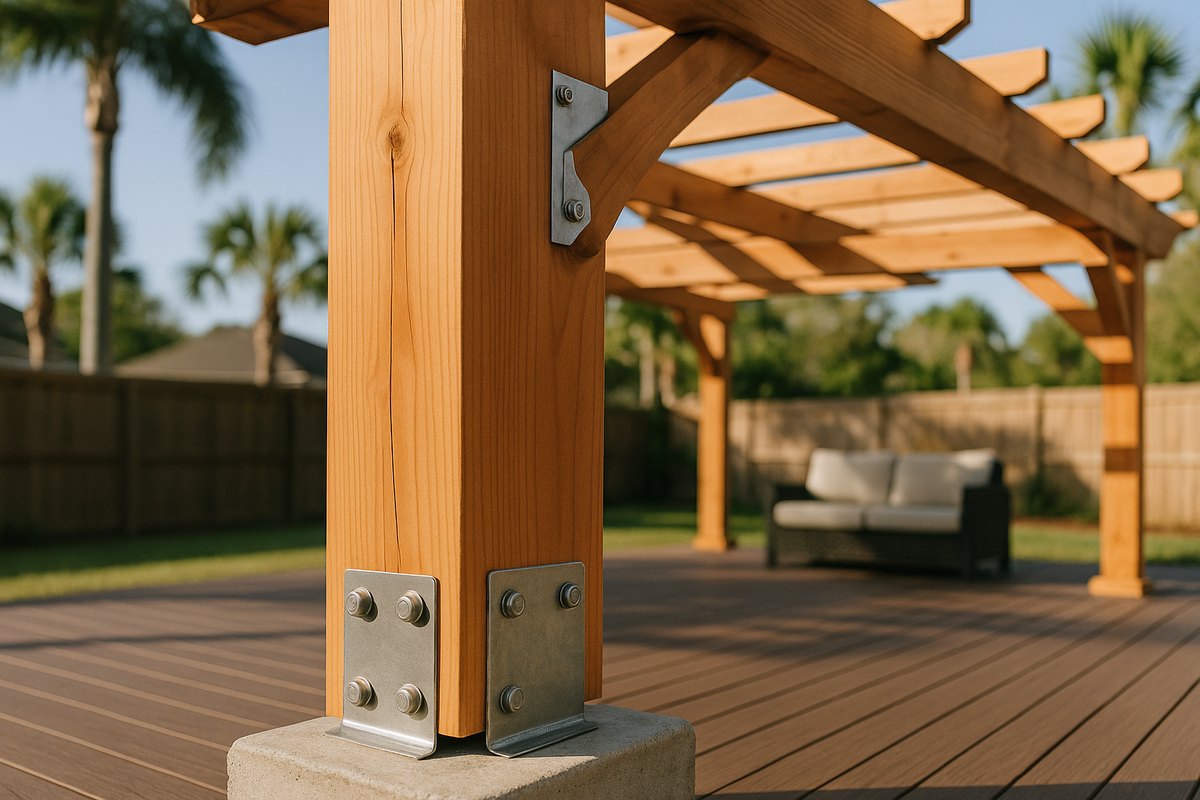
Compare pergola builders on five things you cannot see once the pergola is finished: the footings, the type and grade of material, the hurricane hardware and fasteners, the permit and engineering, and the written warranty. Then ask to see pergolas they built several years ago. A builder who is vague about any of those is telling you where the quote was trimmed.
Get three quotes for a pergola in Jacksonville and they will look surprisingly alike: the same size, the same style, a photo of something handsome and a total at the bottom. Then one builder comes in well below the others, and if you are pricing pergola installation in Jacksonville for the first time, it is hard to tell whether that is a bargain or a warning.
The difference is almost never in the part you can see on day one. It is in the footings, the material grade, the hardware, the engineering and the permit, all of which disappear once the pergola is built and all of which decide how it handles years of Florida sun and storm season. Here is how to compare pergola builders in Jacksonville on the things that matter.
Why pergola quotes are hard to compare
Pergola quotes in Northeast Florida differ in what they include as much as in workmanship. One quote includes engineering, a permit and concrete footings; another assumes the posts will bolt to your existing patio. One prices clear cedar; another prices the cheapest pressure-treated pine on the lot. Before you compare totals, make sure every quote describes the same pergola, built the same way, with the same scope of work.
Footings and posts: where quality starts
Pergolas in Jacksonville, FL take a beating from sun, salt air and summer storms, and a pergola behaves like a sail in a storm. Wind pushes it sideways and, just as importantly, lifts it upward, so the connection to the ground matters as much as the frame above it.
- Concrete footings sized for uplift, with the posts attached through engineered post bases, are the standard for a freestanding pergola.
- Posts bolted to an existing patio can work only if the slab is thick enough and the connection is engineered for it. A thin, old patio slab is not a footing.
- Post size matters. Posts that look elegant on a drawing can be undersized for a large pergola, and they look it once it is built.
Materials: cedar, pressure-treated pine and aluminum
- Pressure-treated pine is strong and economical, but grade and treatment matter. Lumber rated for ground contact holds up better in our humidity, and lumber kiln-dried after treatment twists and checks less as it ages.
- Western red cedar is naturally resistant to rot and insects, stable and handsome, and it takes stain beautifully. It still needs a finish to hold its color in the Florida sun.
- Powder-coated aluminum does not rot or attract termites and suits louvered roofs. Wall thickness and the quality of the powder coat separate a structure that lasts from one that dents and chalks.
- Hardware has to match the material and the location. Near the coast, we use 316 stainless steel hardware.
Our guide to pergola ideas for Jacksonville backyards shows how each material looks finished, and if you want full rain cover, compare a pergola and a pavilion before you decide.
Hurricane hardware and connections
Every connection in a pergola, from post to footing, beam to post and rafter to beam, is a place where wind can pull it apart. Look for rated metal connectors and through-bolts, not toe-nailed or screwed joints, and ask what the fasteners are made of. Ordinary zinc-plated hardware rusts quickly in salt air; hot-dip galvanized or stainless steel is the minimum near the water. It is the same wind-code thinking that goes into hurricane-rated decks.
Permits, engineering and HOA approval
A pergola on footings is a permanent structure, and in Duval, St. Johns, Clay and Nassau counties it generally needs a building permit and engineering for the wind loads at your address. A good builder pulls the permit, provides the engineering and schedules the inspections. A builder who suggests skipping the permit to save money is cutting the one step that proves the pergola was built to code, and an unpermitted structure can cause problems with insurance claims and when you sell. Most HOAs also want to approve the design, size and color before work starts.
A quality checklist for comparing pergola builders in Jacksonville
| Checkpoint | What a quality build looks like | Red flag |
|---|---|---|
| Footings | Concrete footings sized for uplift and engineered post bases | Posts bolted to an old patio of unknown thickness |
| Material | Graded cedar, ground-contact pressure-treated pine or powder-coated aluminum | An unspecified "wood" or "aluminum" on the quote |
| Hardware | Rated connectors and through-bolts, stainless or hot-dip galvanized near the coast | Screws and nails at the main connections |
| Permit and engineering | Permit pulled by the builder with engineered plans | "You don't need a permit for this" |
| License and insurance | Florida-licensed contractor with insurance on file | No license number on the quote |
| Warranty | A written warranty on workmanship | Verbal promises only |
| Past work | Pergolas several years old that you can see | Only renderings and brand-new photos |
Questions to ask any pergola builder
- What are the footings, and how are the posts attached to them?
- What exact material and grade are you pricing?
- What hardware and fasteners will you use, and are they rated for coastal exposure?
- Will you pull the permit and provide the engineering?
- What is your Florida license number, and can I see your insurance?
- What does your warranty cover, and for how long?
- Can I see pergolas you built three or more years ago?
When an old pergola should be replaced
If you already have a pergola that is leaning, rotting at the base of the posts or pulling apart at the connections, the problem is usually structural, and patching the visible damage does not fix it. A replacement built on proper footings, with the right hardware and a permit, is the lasting fix. We build new pergolas and handle full replacements; we do not take on small repairs to existing structures.
Why homeowners choose Jacksonville Deck Builders
We are a Florida-licensed general contractor and a Coastal Outdoor Construction brand, building decks, pergolas, porches and outdoor living spaces across Duval, St. Johns, Clay and Nassau counties since 2013. Every pergola we build is engineered for Florida's wind code, permitted on your behalf and finished with hardware chosen for its location, including 316 stainless steel on coastal builds. See our custom pergolas in Jacksonville for materials, styles and recent work, and our guide to choosing a deck builder in Jacksonville if a new deck is part of the plan.