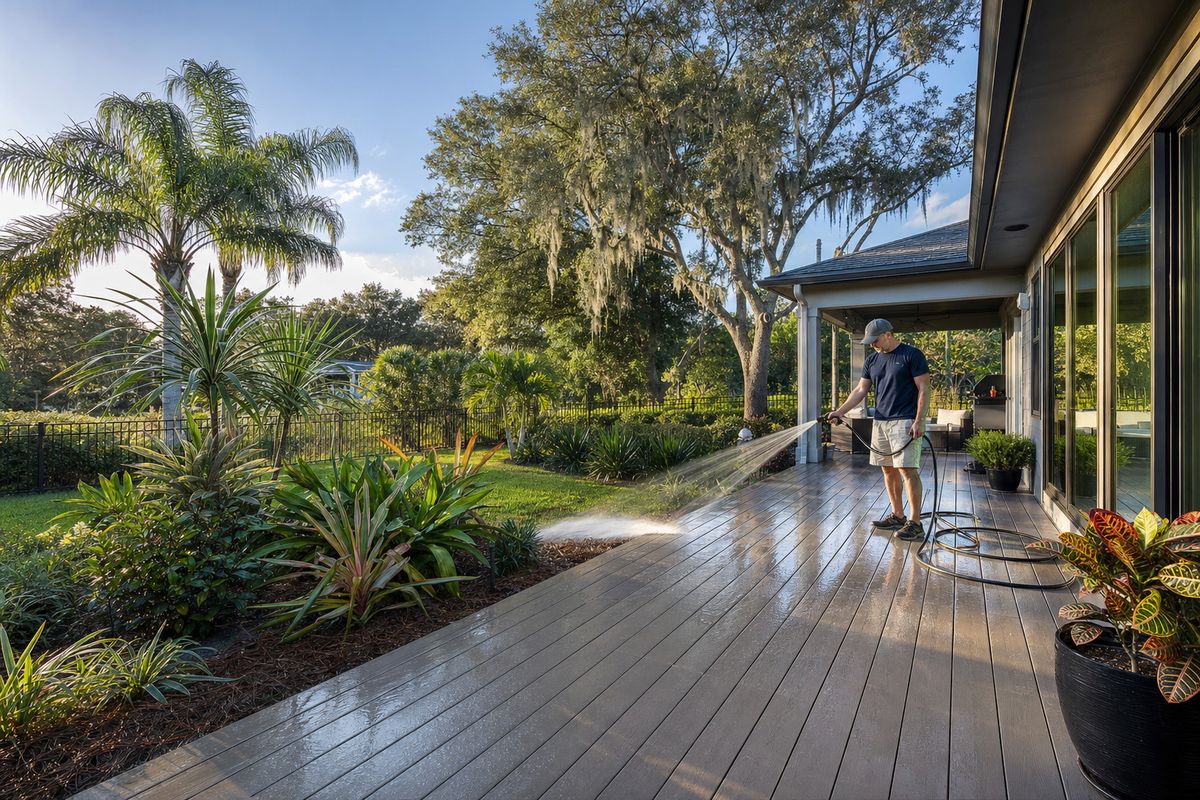
In Northeast Florida, plan to give your deck a light rinse every month, a deep clean twice a year (spring and fall), and a full inspection once a year. Wood decks also need a fresh seal or stain every 1-2 years. Composite and PVC decks skip the sealing but still need regular washing to fight our humidity and mold.
- Monthly: Sweep and rinse off dirt, pollen, and salt.
- Twice a year: Deep clean the whole deck (spring + fall).
- Yearly: Inspect boards and hardware; re-seal wood as needed.
Florida is tough on decks. Between the strong sun, the salt air off the coast, the daily summer storms, and humidity that never quits, your deck takes a beating all year. The good news: a little steady care goes a long way. You do not need to be handy. You just need a simple schedule and a few minutes each month.
| Season | What to do | Why it matters here |
|---|---|---|
| Spring (Feb-Apr) | Deep clean the whole deck; inspect boards, railings, and hardware | Clears winter pollen and mold before the hot, wet season starts |
| Summer (May-Aug) | Monthly rinse; clear debris and standing water after storms | Daily rain and humidity grow mildew fast |
| Fall (Sep-Nov) | Second deep clean; re-seal wood if water no longer beads | Removes salt and grime left by storm season |
| Winter (Dec-Jan) | Monthly rinse; light check for loose fasteners | Cooler, drier stretch is a good time for small fixes |
Here is the short version. In Jacksonville and across Duval, St. Johns, Nassau, and Clay counties, rinse your deck monthly, deep clean it twice a year, and inspect it once a year. If you have a wood deck, add a fresh seal or stain every one to two years. Below is the full plan, broken down so it is easy to follow.
Why Florida decks need their own schedule
A maintenance plan built for a deck in Ohio does not fit a deck in Northeast Florida. Our climate is different, so our care is different. Here is what your deck fights every year:
- Humidity and mold. Warm, damp air lets mildew and green algae grow fast, especially on shady decks.
- Salt air. If you live near the coast or the Intracoastal, salt settles on surfaces and speeds up wear.
- UV sun. Our sun fades color and dries out wood faster than in cooler states.
- Storms and wind. Summer downpours and gusts drop debris and leave standing water in corners.
Because of all this, the goal is simple: keep the surface clean and dry, and catch small problems before they turn into big ones.
Monthly: the five-minute rinse
Once a month, sweep off leaves, pollen, and dirt. Then hose down the boards. Pay attention to shady spots and low corners where water pools, since that is where mold likes to start. If you live near the water, this monthly rinse also washes off salt before it builds up.
That is it. This one habit does more to protect your deck than anything else on this list.
Twice a year: the deep clean
Two times a year, give the whole deck a real wash. Spring (before the summer heat) and fall (after the storm season) are the best windows in our area. A deep clean lifts off the grime, mildew, and salt that a quick rinse leaves behind.
How you clean depends on your material. Composite boards like Trex and MoistureShield just need soap, water, and a soft brush. The steps matter, though, so we wrote a full guide on how to clean composite decking the right way without damaging the surface. Skip the pressure washer on high settings; it can dent or streak the boards.
Wood decks (pressure-treated, cedar, or Ipe) can handle a gentle wash too, but go easy. Too much pressure raises the grain and chews up the surface. A deck brush and a cleaner made for wood is the safe path.
Yearly: the full inspection
Once a year, walk your deck slowly and look closely. This is where you catch the little stuff early. Check for:
- Loose or popped screws and nails.
- Soft, spongy, or cracked wood boards.
- Wobbly railings or steps.
- Standing water or spots that never seem to dry.
- Rusty or corroded hardware, which is common near salt air.
Railings deserve extra attention. Give every rail a firm shake. A rail that moves is a safety issue, and one you want fixed fast. Florida also has strict building rules for how decks are anchored and how they hold up in high wind (our code targets 130-150 mph). A yearly look keeps you ahead of trouble.
Wood decks: seal or stain every 1-2 years
This step is only for wood. Composite and PVC never need sealing. But pressure-treated, cedar, and Ipe decks need a fresh coat of sealer or stain every one to two years in our climate. Our sun and rain strip protection faster than up north, so do not stretch it to three or four years.
A simple test: splash a little water on the boards. If it beads up, your seal is still working. If it soaks in and darkens the wood, it is time to re-coat. Learn more about caring for real wood on our wood decks in Jacksonville page.
Composite and PVC: less work, still not zero
If you want the lowest-maintenance deck, composite and PVC are the way to go. There is no sealing, no staining, and no splinters. But "low maintenance" is not "no maintenance." Our humidity still grows mold on any surface, so the monthly rinse and twice-a-year clean still apply.
Thinking about switching from wood to a board that shrugs off Florida weather? See the options on our composite decking in Jacksonville page.
Your year-round deck maintenance calendar
Here is the whole plan in one place, matched to Northeast Florida's seasons.
What if your deck is past saving?
Sometimes maintenance is not enough. If your boards are rotting, the frame is soft, or the whole thing feels unsafe, patching it is throwing money at a problem that will come back. That is where we come in. Jacksonville Deck Builders, a Coastal Outdoor Construction brand, has built and replaced 500+ decks across Northeast Florida since 2013. We are a fully insured, FL-licensed general contractor and an authorized Trex and MoistureShield contractor, and we build new decks and full replacements (we do not do repairs or refinishing).
If it is time for a new deck, we build with the materials that hold up best here: composite like Trex and MoistureShield, AZEK PVC, Ipe and cedar hardwoods, pressure-treated wood, pavers, and aluminum. A new 12x12 deck typically runs about $2,900-$6,000 installed, depending on the material you choose.
Want a deck that stands up to Florida and needs less upkeep? Call Jacksonville Deck Builders at (904) 944-9253 for a free, no-pressure quote. We will walk your property and give you honest options.
We are proud to serve homeowners across Duval, St. Johns, Nassau, and Clay counties, and we hold a 4.9-star rating on 70 Google reviews. Whether you keep your current deck in top shape with this schedule or you are ready to build new, we are here to help. Call (904) 944-9253 today.