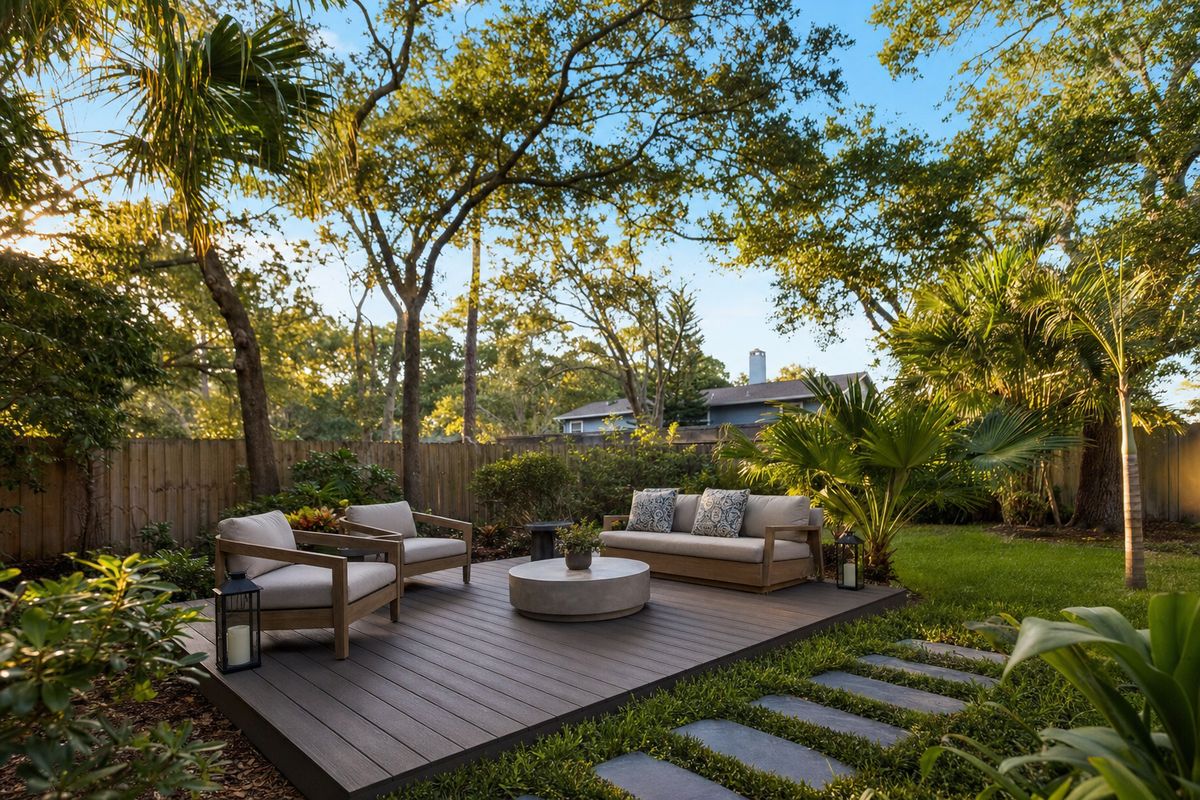
A floating deck is a low, freestanding platform that rests on the ground on blocks or small footings and is not bolted to your house. In Jacksonville it works best for flat backyards, small ground-level patios, and spots where you want a deck without tearing into the home's exterior. It is not a fit for raised decks, sloped yards, or any deck you plan to attach to the house.
- Best for: flat lots, low platforms under a foot or two off the ground, and hot-tub or fire-pit pads.
- Not for: elevated decks, steep grades, or second-story access.
- Still needs a permit: most decks in Duval, St. Johns, Nassau, and Clay counties do, even low ones.
A floating deck is a deck that sits on top of the ground instead of being tied to your house. It rests on concrete blocks or small footings and holds itself up. Nothing bolts into the side of your home. That is the whole idea, and it is why people also call it a freestanding or ground-level deck.
| Material | Installed cost (per sq ft) | Good fit for a floating deck? |
|---|---|---|
| Pressure-treated pine | $20-30 | Yes - budget-friendly option |
| Composite (Trex, MoistureShield) | $28-42 | Yes - best moisture resistance near the ground |
| AZEK PVC + Ipe hardwood | $20-30 | Yes - premium look, rot-resistant |
| Pavers / aluminum | Priced by project | Case by case |
| 12x12 floating deck (typical) | ~$2,900-$6,000 installed | Common backyard size |
At Jacksonville Deck Builders, a Coastal Outdoor Construction brand, we have built over 500 decks across NE Florida since 2013. Floating decks come up a lot in first calls, usually because a homeowner heard they are cheaper or easier. Sometimes that is true. Sometimes it is the wrong call for the yard. Here is the honest version so you can tell which one you have.
How a floating deck is different from a regular deck
Most decks are attached decks. A board called a ledger bolts to your house, and the deck hangs off that ledger with posts on the far side. It becomes part of the home's structure.
A floating deck skips the ledger. It stands on its own frame, spread across blocks or footings on the ground. Because it is low and separate, it moves a little on its own and does not put any load on your walls. That independence is the main reason to choose one.
When a floating deck actually works in Jacksonville
Floating decks shine in a few specific situations we see all over Duval and St. Johns:
- Flat backyards. Our coastal lots are often level. A flat yard is the easiest place to set a floating deck evenly.
- Low platforms. If you want a deck only a step or two off the ground, floating is a clean, simple build.
- Fire-pit and lounge zones. A freestanding platform out in the yard, away from the house, is a great spot for seating or a fire feature.
- Hot-tub pads. A well-built ground-level frame can carry a hot tub without touching the house.
- Rentals or homes you may sell. Since nothing bolts into the exterior, there is no wall penetration to worry about later.
If your yard is flat and you want something low and simple, this is often the smart, budget-friendly path.
When a floating deck is the wrong choice
This is where we save homeowners from a mistake. A floating deck does not work when:
- You want a raised deck. Anything more than a foot or two off the ground should be a properly footed, attached structure. Do not float a tall deck.
- Your yard slopes. Grade changes make a floating build wobble or sit unevenly. Sloped lots need real footings and often posts of different heights.
- You need it off a back door or second floor. Deck access from the house almost always means an attached deck.
- You want one big connected outdoor space. If the deck should feel like part of the home, attach it.
Florida also has strong wind rules. Our region falls in the 130 to 150 mph wind zone, and the Florida Building Code expects decks to be anchored to handle it. A low floating deck can be engineered and secured to meet code, but a tall or poorly anchored one is a real problem in a storm. We build every deck, floating or attached, to hold up in NE Florida weather.
Do you still need a permit?
Usually, yes. Even low decks typically need a permit in Duval, St. Johns, Nassau, and Clay counties. Rules vary by county and by how the deck is built, so the size and height that trigger a permit are not the same everywhere. We handle permitting for you and pull the right one for your address. You can also confirm requirements through the City of Jacksonville for Duval County projects. The short version: do not assume a floating deck skips the permit. Get it right the first time so it is legal and safe.
What materials work best
A floating deck sits close to the ground, so moisture and airflow matter more than on a raised deck. That makes material choice important in our humid climate.
We build floating decks in the same materials as any other deck. Pressure-treated pine is the budget option. Composite, including Trex and MoistureShield, holds up beautifully near the ground and shrugs off Florida moisture. AZEK PVC and Ipe hardwood are premium picks that look incredible and resist rot. As an authorized Trex and MoistureShield contractor, we can steer you to the right board for a low deck. For a full breakdown, see our guides on composite decking in Jacksonville and wood decks in Jacksonville.
What does a floating deck cost?
Floating decks are priced by material and size, just like attached decks. Our installed per-square-foot ranges are below. A typical 12x12 floating deck runs about $2,900 to $6,000 installed, depending on the boards you pick. For a deeper look at what drives the number, read our cost to build a custom deck in Jacksonville guide.
Not sure if your yard is a fit for a floating deck? We will tell you straight. Call Jacksonville Deck Builders at (904) 944-9253 for a free, no-pressure look at your project.
The bottom line
A floating deck is a great tool for the right yard: flat, low, and separate from the house. It is the wrong tool for raised decks, sloped lots, and anything that ties into your home. We build new decks and full replacements only, so if you want it done right and built to Florida code, we will design a floating deck that fits your space or tell you honestly when an attached deck is the better move.
With a 4.9-star rating on Google, a Florida-licensed GC on every job, and full insurance, we make the whole process simple. Call (904) 944-9253 to get started.