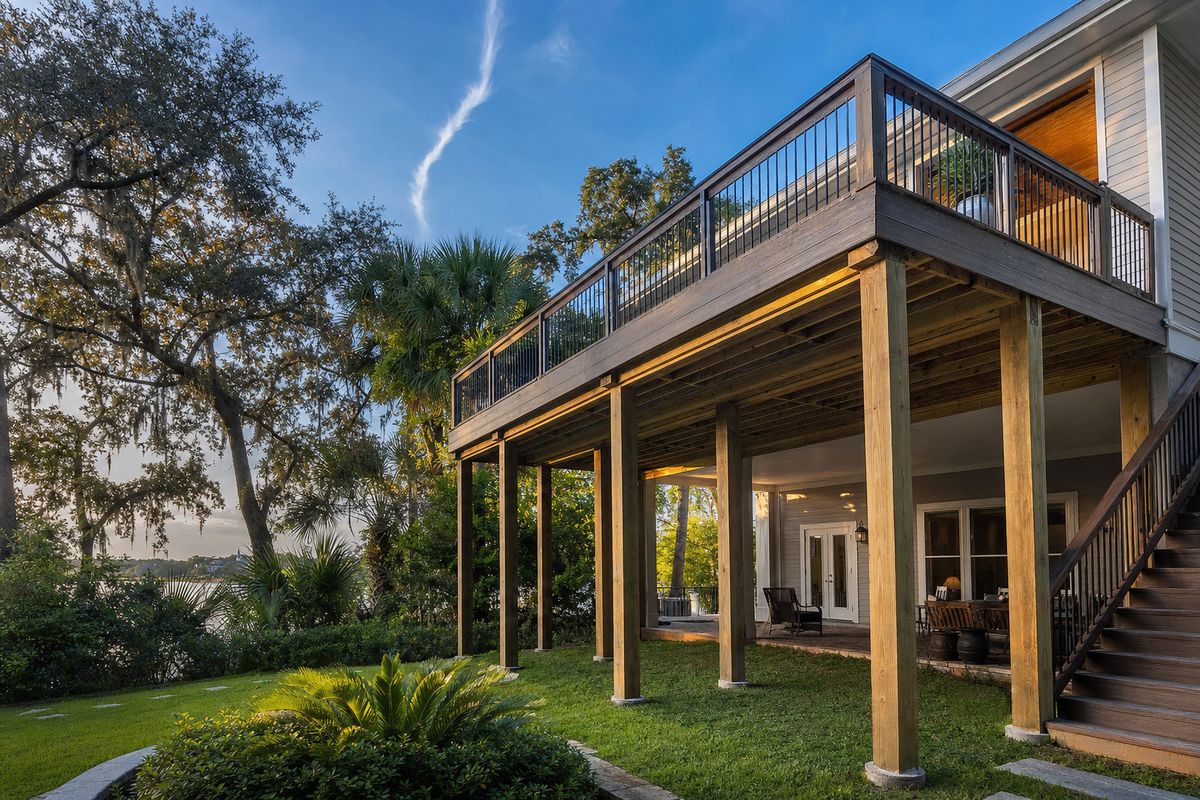
A hurricane-rated deck in Jacksonville and NE Florida is built to meet the Florida Building Code wind rating of 130-150 mph, which means the whole structure is engineered to hold together in a major storm. The single most important upgrade is the connection hardware: galvanized or stainless steel framing connectors, hurricane ties, and through-bolted ledger attachments that keep the deck from pulling apart or lifting off the house in high wind.
- NE Florida sits in a 130-150 mph wind zone, so a permitted deck must use rated metal connectors at every joist, beam, and post, not just nails.
- The ledger board (where the deck attaches to your house) must be through-bolted with flashing, because a failed ledger is the most common way decks come apart in a storm.
- Footings and posts must be sized and anchored for uplift, so wind cannot lift the deck up and off its supports. A permitted, inspected build in Duval, St. Johns, Nassau, or Clay County confirms it meets code.
A hurricane-rated deck in Florida is one that is built and permitted to hold up against the wind speeds in your local building code. In Jacksonville and across NE Florida, that means designing the deck for sustained winds in the 130 to 150 mph range, using stronger connections, deeper footings, and code-approved hardware.
If you live near the coast, this matters more than the boards you walk on. A beautiful deck means nothing if the structure underneath it fails in a storm. Here is what "hurricane-rated" really means, and how we build to it.
What "Florida wind code" actually means
Florida has some of the toughest building rules in the country. That is on purpose. We get hurricanes, so the state requires homes and decks to be built for high winds.
The wind speed your deck must handle depends on where you live. In our service area, the design wind speed falls in the 130 to 150 mph range. Homes closer to the ocean usually sit at the higher end. Homes further inland are often a little lower. Your exact number comes from the local building department when we pull the permit.
This is not a suggestion. It is law. Every deck we build in Duval, St. Johns, Nassau, and Clay counties has to meet the wind code for that address before it passes inspection.
What makes a deck hurricane-rated
A storm does not just push a deck sideways. Wind also lifts. It tries to pull the deck up and away from the house. So a hurricane-rated deck has to resist both forces. Here is what goes into that.
- Deeper, stronger footings. The posts have to be anchored into concrete that goes deep enough and meets code for our soil. This keeps the deck from shifting or lifting.
- Rated metal connectors. We use hurricane ties, post bases, and joist hangers that are stamped and approved for high-wind zones. These metal pieces tie the whole frame together so it acts as one unit.
- A proper ledger connection. Where the deck attaches to your house is the most important joint of all. It has to be bolted, flashed, and sealed correctly. A bad ledger connection is a common reason decks fail.
- Correct beam and joist spacing. The framing has to be sized for the load and the span. We do not stretch lumber past what the code allows.
- Code-approved railings. Railings have to handle a set amount of force without giving way. This is a safety rule, storm or not.
When all of these work together, you get a deck that is built to ride out a storm, not get swept up in one.
Does the decking material change the wind rating?
This is a common question, and the answer surprises people. The wind rating comes from the structure, not the surface. The frame, the footings, and the connections do the heavy lifting.
That said, the boards still matter for how a deck holds up in our coastal climate. Salt air, heavy rain, and humidity wear materials down fast in NE Florida. So while the wind rating comes from the frame, the right material keeps your deck standing strong for years after the storm passes.
Here is how the common choices compare for our area:
- Composite (Trex, MoistureShield). A great fit for our weather. It resists moisture, rot, and warping, and it does not splinter. Many homeowners in Mandarin, Ponte Vedra, and Nocatee go this route. You can read more on our composite decking in Jacksonville page. We are an authorized Trex and MoistureShield contractor.
- PVC (AZEK). Fully synthetic and our top-tier option for coastal homes. It handles salt and moisture extremely well. It is a premium material priced at $20–30 per sq ft.
- Ipe (hardwood). A dense, beautiful hardwood that lasts a long time. It is also a premium, top-of-the-range choice.
- Cedar and pressure-treated pine. The most budget-friendly wood options. They need more upkeep to handle our humidity over time.
- Pavers and aluminum. Used for specialty builds and certain pool deck designs.
No matter the material, the frame underneath is built to the same wind code. A pretty board on a weak frame is a bad deal. We never cut that corner.
Want to know if your current deck meets today's wind code, or what a hurricane-rated build would cost at your address? We offer a free, no-pressure in-home estimate across NE Florida. Call us at (904) 944-9253 and we will give you a real number.
What a hurricane-rated deck costs in NE Florida
Pricing depends on size, material, height, and how complex the design is. Here are rough installed ranges to set expectations. These are starting points, not quotes.
- Pressure-treated pine: about $20 to $30 per square foot.
- Composite, including Trex and MoistureShield: about $28 to $42 per square foot.
- AZEK PVC and Ipe hardwood: the premium material, at a competitive $20–30 per sq ft.
A hurricane-rated build can cost a little more than a basic deck because of the deeper footings, the rated hardware, and the engineering needed to pass inspection. It is worth it. You are paying for a deck that stays put when the weather turns.
The only way to get a real number is a free in-home estimate. We measure, look at your soil and your house, and give you an estimate. If you are replacing an old deck, demo and haul-away of the old structure is free with your new build.
Pool decks and beachfront builds
If your deck wraps a pool or sits near the water, the wind code still applies, and the material choice gets even more important. Salt and chlorine are hard on decking. We design pool decks in Jacksonville to handle moisture, slips, and storms at the same time.
Beachfront homes face the strongest winds in our area. If you are in Atlantic Beach or another oceanfront spot, the design wind speed requirement is usually at the higher end, around 150 mph. Our Atlantic Beach deck builders know these coastal rules well and build every frame to match.
Why work with Jacksonville Deck Builders
We have built decks across NE Florida since 2013. That is more than 500 decks in Jacksonville and the surrounding counties. We hold 4.9 stars on Google. We are a Florida-licensed general contractor and fully insured.
We do new builds and full deck replacements only. We are not a repair or patch service. When we build your deck, it is engineered, permitted, and inspected to meet the wind code for your exact address, from San Marco and Riverside to Ponte Vedra and the beaches.
Get a free hurricane-rated deck estimate
If you want a deck that is built to handle a Florida storm, we are ready to help. Call Jacksonville Deck Builders at (904) 944-9253 for your free in-home estimate. We will walk your space, answer your questions, and give you a clear estimate with no pressure.