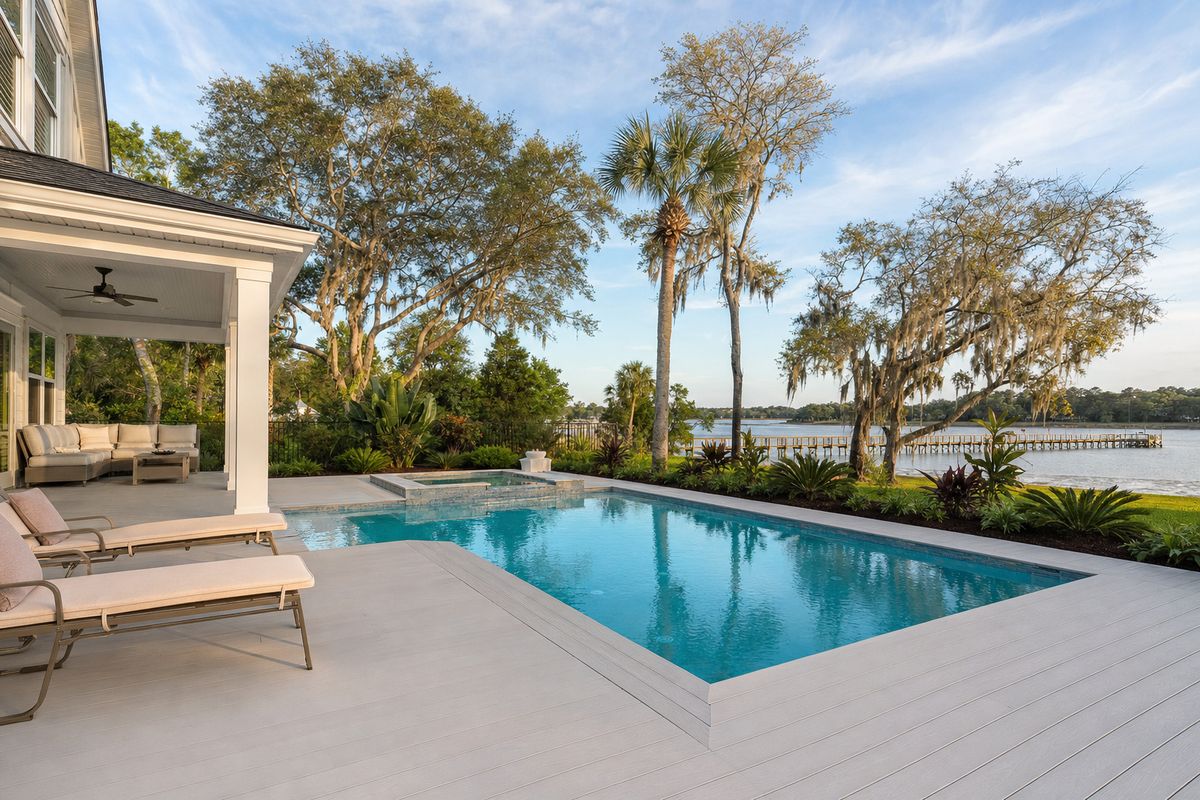
The best deck materials for a saltwater pool in Jacksonville are composite (Trex or MoistureShield), AZEK PVC, and Ipe hardwood. All three shrug off salt, resist rot, and stay stable in NE Florida heat and humidity. Composite runs $28-42 per square foot installed. AZEK PVC and Ipe run $20-30 per square foot as premium materials at a competitive price.
- Composite and PVC will not rust, splinter, or absorb saltwater like an untreated wood deck.
- Skip standard pressure-treated wood right next to a saltwater pool unless budget is the top priority.
- Every option here is built to Florida's 130-150 mph wind code across Duval, St. Johns, Nassau, and Clay counties.
If you have a saltwater pool in Jacksonville, the best deck materials are composite (Trex or MoistureShield), AZEK PVC, and Ipe hardwood. These stand up to salt, sun, and humidity far better than untreated wood. Composite is the most expensive tier at $28-42 per square foot installed. AZEK PVC and Ipe give you a premium surface at a competitive price, $20-30 per square foot installed. Pressure-treated wood is the budget pick at $20-30, but it needs more care next to salt.
Saltwater pools are gentler on your skin than chlorine. They are not gentler on a deck. Salt mist settles on the surface, dries, and works its way into wood and cheap fasteners. Over time that means warping, splintering, rot, and rusty screws. In a coastal city like Jacksonville, you also get strong sun and heavy humidity. The right material handles all three at once.
Why saltwater changes the material choice
Chlorine pools sit in the water. Saltwater pools spread a fine salt film across everything nearby every time someone splashes or the wind kicks up. That film is the problem. It pulls moisture, speeds up rot in natural wood, and eats away at low-grade metal hardware.
So near a saltwater pool you want three things. A surface that does not soak up water. Fasteners that will not rust. And a material that stays put in Jacksonville heat instead of cupping or cracking. That points you toward composite, PVC, and dense tropical hardwood. For a full side-by-side of every option we build, see our guide to the best pool deck materials in Jacksonville.
| Material | Installed cost (per sq ft) | Saltwater performance | Upkeep |
|---|---|---|---|
| Composite (Trex, MoistureShield) | $28-42 (highest tier) | Excellent, will not rot or absorb salt | Very low, just rinse |
| AZEK PVC | $20-30 (premium at a competitive price) | Excellent, no wood to rot | Very low |
| Ipe hardwood | $20-30 (premium at a competitive price) | Very good, dense and rot-resistant | Occasional oiling for color |
| Pressure-treated wood | $20-30 (budget) | Fair, needs sealing and coated fasteners | Higher, regular sealing |
| Pavers | Priced by project | Excellent, non-slip and rot-free | Low |
| Aluminum | Priced by project | Excellent, rust-proof | Very low |
Composite: the easiest choice near saltwater
Composite decking, like Trex and MoistureShield, is the simplest answer for most saltwater pool owners. The boards are made from wood fibers and recycled plastic wrapped in a tough shell. They do not absorb saltwater, do not rot, and never need sanding, staining, or sealing. A quick rinse keeps salt film from building up.
Composite is the most expensive tier at $28-42 per square foot installed. You pay more up front, and you get the least maintenance in return. For a saltwater pool that sees heavy use, that trade is usually worth it. We are an authorized Trex and MoistureShield contractor, so we build with the boards we recommend. Barefoot-friendly, cooler surface options exist within these lines too, which matters on a Jacksonville summer afternoon.
AZEK PVC: no wood at all
AZEK is a PVC deck board with no wood in it. Because there is nothing organic to rot, it handles salt and standing moisture extremely well. It stays cooler underfoot than many boards, resists stains from sunscreen and food, and holds its color in strong sun.
The best part for a budget-minded homeowner: AZEK PVC is a premium material at a competitive price, $20-30 per square foot installed. You get a top-tier surface for less than composite. For a saltwater pool where you want zero rot worries and a clean look, AZEK is a strong pick.
Ipe: dense tropical hardwood that fights salt
If you want real wood, Ipe is the one to use near saltwater. It is a dense Brazilian hardwood, so tight that it naturally resists rot, insects, and moisture. It takes salt exposure far better than cedar or pressure-treated pine and gives you a rich, natural grain.
Ipe is a premium material at a competitive price, $20-30 per square foot installed, the same range as AZEK. The trade-off is upkeep. To keep that deep brown color, Ipe needs an oil treatment now and then. Skip the oil and it fades to a silver-gray, which some homeowners actually prefer. Either way the wood stays strong.
Pavers and aluminum
Two more options work well around a saltwater pool. Concrete pavers give you a solid, non-slip surface that does not rot and stays cool in light colors. Aluminum decking is rust-proof, extremely light, and popular for raised decks. Both are priced by project rather than a flat per-square-foot rate, since layout, base prep, and framing drive the cost. We will size these in your free quote.
What about pressure-treated wood and cedar?
Pressure-treated pine is the budget option at $20-30 per square foot installed. It can work near a saltwater pool, but it needs the most care. Plan on sealing it regularly and using coated or stainless fasteners so nothing rusts. Cedar looks great and naturally resists rot, but it is soft and shows wear faster next to constant salt spray. Both are fine choices if the budget is tight, just know the upkeep going in.
Built for Jacksonville and NE Florida
Whatever material you pick, the build has to meet Florida's wind code. In our area that means framing and fastening for 130-150 mph winds. We build to that standard on every deck across Duval, St. Johns, Nassau, and Clay counties, and we pull the right permits for your county. For the full breakdown of how salt and heat affect each board, read our guide on the best decking for Florida heat and salt.
Jacksonville Deck Builders is a Coastal Outdoor Construction brand. We have built decks across Northeast Florida since 2013, more than 500 of them. We are a FL-licensed general contractor, fully insured, and rated 4.9 stars on Google. We handle new builds and full replacements only. If your saltwater pool deck is ready for an upgrade, this is the crew to call.
Ready to design a saltwater pool deck that lasts? See our pool deck services in Jacksonville or call for a free, no-pressure quote.
A 12x12 deck runs roughly $2,900-$6,000 installed depending on the material and site. We will walk your yard, talk through your options, and give you a clear number. Call Jacksonville Deck Builders at (904) 944-9253 to get started.