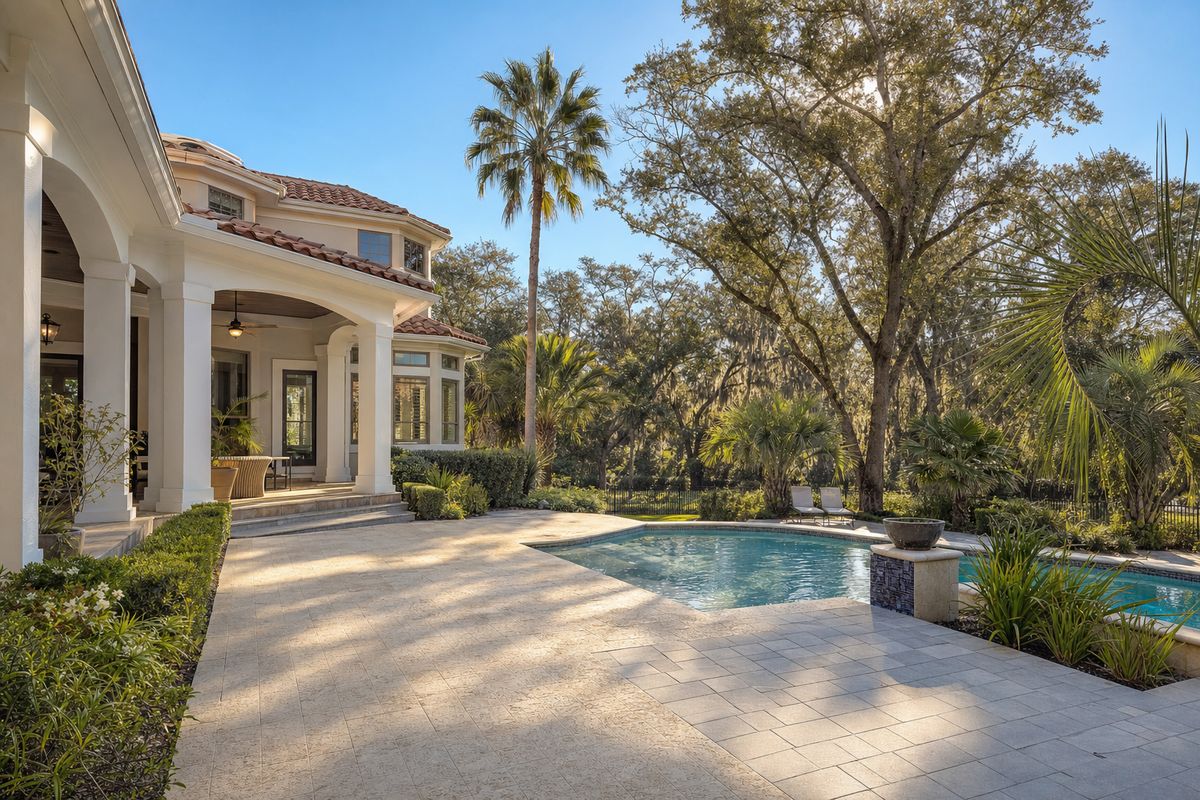
For most Jacksonville and NE Florida homeowners, travertine pavers handle the heat, sun, and humidity better than concrete pavers. Travertine stays noticeably cooler underfoot in direct sun and naturally resists fading, while concrete pavers cost less up front but tend to hold heat and fade faster under Florida's intense UV. Concrete is the budget pick; travertine is the comfort-and-looks pick for pool decks and patios.
- Travertine is a natural stone that stays cooler than concrete in full Florida sun, which matters most around pools and on open patios.
- Concrete pavers usually cost less per square foot but fade and can develop surface wear sooner in NE Florida's strong UV and humidity.
- Both can be set to handle Florida's wind and weather when properly installed by a licensed contractor across Duval, St. Johns, Nassau, and Clay counties.
Travertine pavers stay cooler underfoot and look high-end, which makes them a favorite around pools. Concrete pavers cost less, come in more colors and shapes, and are easier to find. Both work well in Florida. The right pick depends on your budget, where you're putting them, and the look you want.
| Factor | Travertine Pavers | Concrete Pavers |
|---|---|---|
| Up-front cost | Higher; priced by project | Lower; priced by project |
| Heat underfoot | Stays cooler in direct sun | Holds more heat in full sun |
| Sun fading (UV) | Natural color resists fading | Color can fade faster over time |
| Humidity / slip | Naturally non-slip, good for pool decks | Can get slick unless textured or sealed |
| Upkeep | Periodic sealing; spot-replace pavers | Periodic sealing; may need re-coloring |
| Lifespan | Long-lasting natural stone | Long-lasting when sealed and maintained |
| Best for | Pool decks, patios, higher-end look | Walkways, driveways, budget patios |
If you're a homeowner in Jacksonville or anywhere in NE Florida, you've probably seen both. Here's a plain-English breakdown so you can choose with confidence.
What Are Travertine and Concrete Pavers?
Travertine is a natural stone. It's pulled from the earth, cut into tiles, and finished. Every piece has its own color and texture, so no two patios look exactly alike. It has a soft, light, earthy look that many people love near water.
Concrete pavers are man-made. They're poured into molds, so they come in lots of shapes, sizes, and colors. Some are even made to look like stone, brick, or wood. They're a workhorse material that fits almost any style.
Heat: A Big Deal in Florida
This matters more here than almost anywhere. Our summers are long and the sun is strong.
Travertine has natural pores that help it stay cooler when the sun beats down. If you're walking barefoot around a pool in July, that's a real comfort. This is the main reason a lot of Florida homeowners choose it for pool decks in Jacksonville.
Concrete pavers can get warmer in direct sun, especially darker colors. You can soften that by picking lighter shades, but if cool-to-the-touch is your top goal, travertine usually wins.
Cost: Concrete Is Friendlier on the Wallet
For most homeowners, budget drives the decision.
- Concrete pavers generally cost less to buy and install. You get a big, finished look for less money.
- Travertine is a premium, natural-stone material, so it usually costs more up front. You're paying for the natural look and the cooler surface.
Prices swing based on the size of the project, the pattern, site prep, and how your yard drains. That's why we never quote a paver job off a phone call. A free in-home estimate is the only way to get a real number for your space.
Looks and Style
Travertine has a calm, natural feel. The colors are soft creams, tans, and grays. It reads as upscale and ages gracefully. It's a great match for a coastal home in Ponte Vedra or a classic look in San Marco.
Concrete pavers give you more freedom. Want a modern gray patio in Riverside? A warm brick look in Mandarin? A clean, simple layout in Nocatee? Concrete has a style for it. You also get more pattern and edging options.
Not sure which look fits your home? We'll bring samples to your door and show you both side by side. Call Jacksonville Deck Builders at (904) 944-9253 for a free in-home estimate.
Upkeep and Maintenance
Both materials need basic care to look their best, but they're a little different.
Travertine is a softer natural stone. It does best with periodic sealing to guard against stains and our heavy humidity. It can also be a touch more sensitive to acids, so you'll want to wipe up spills like citrus or pool chemicals fairly soon.
Concrete pavers are tough and forgiving. They can fade a bit over years of strong Florida sun, and sealing helps keep the color rich. If one paver ever gets badly stained, the unit can be lifted and swapped.
One honest note: Jacksonville Deck Builders builds new outdoor spaces and does full replacements. We don't run a repair or maintenance service. We share upkeep tips here to help you, not to sell you a cleaning plan.
Durability in Our Climate
Both hold up well in NE Florida when they're installed right. The secret isn't just the paver. It's the base underneath.
Florida sand, heavy summer rain, and high water tables can wreck a patio if the prep is sloppy. A proper compacted base, the right edge restraints, and good drainage are what keep your pavers flat and even for years. We've been building across Duval, St. Johns, Nassau, and Clay counties since 2013, with 500+ decks and outdoor spaces built, so we know how to prep for our soil and storms.
Which Should You Pick?
Here's the short version.
- Pick travertine if you want a cooler surface, a natural high-end look, and you're comfortable with a higher budget and occasional sealing. It shines around pools.
- Pick concrete pavers if you want strong value, the most style and color choices, and a tough, low-fuss surface for an everyday patio.
There's no wrong answer. Plenty of homeowners use travertine right by the water and concrete for the rest of the yard. If you're planning a new patio in Jacksonville, we can help you mix materials so each space gets the right one.
Why Homeowners Trust Jacksonville Deck Builders
We're a Coastal Outdoor Construction brand, and we've been building outdoor spaces across NE Florida since 2013. We're a Florida-licensed general contractor, fully insured, and rated 4.9 stars on Google. We build new patios, pool decks, and full deck replacements, and we do it the right way from the base up. If you're replacing an old structure, demo and haul-away are included free with your replacement.
We also build decks in composite, wood, and PVC. We're an authorized Trex and MoistureShield contractor. For composite decking, including Trex and MoistureShield, expect roughly $28 to $42 per square foot installed. Pressure-treated pine runs about $20 to $30. AZEK PVC and Ipe hardwood are our premium material and sit at a competitive $20–30 per sq ft. Your free in-home estimate gives you a real number for your project.
Ready to Plan Your Outdoor Space?
Whether you're leaning travertine, concrete pavers, or a deck, we'll walk your yard, show you samples, and give you straight answers with no pressure. Call Jacksonville Deck Builders today at (904) 944-9253 to book your free in-home estimate. We serve Duval, St. Johns, Nassau, and Clay counties, including Mandarin, Ponte Vedra, San Marco, Atlantic Beach, Nocatee, and Riverside.