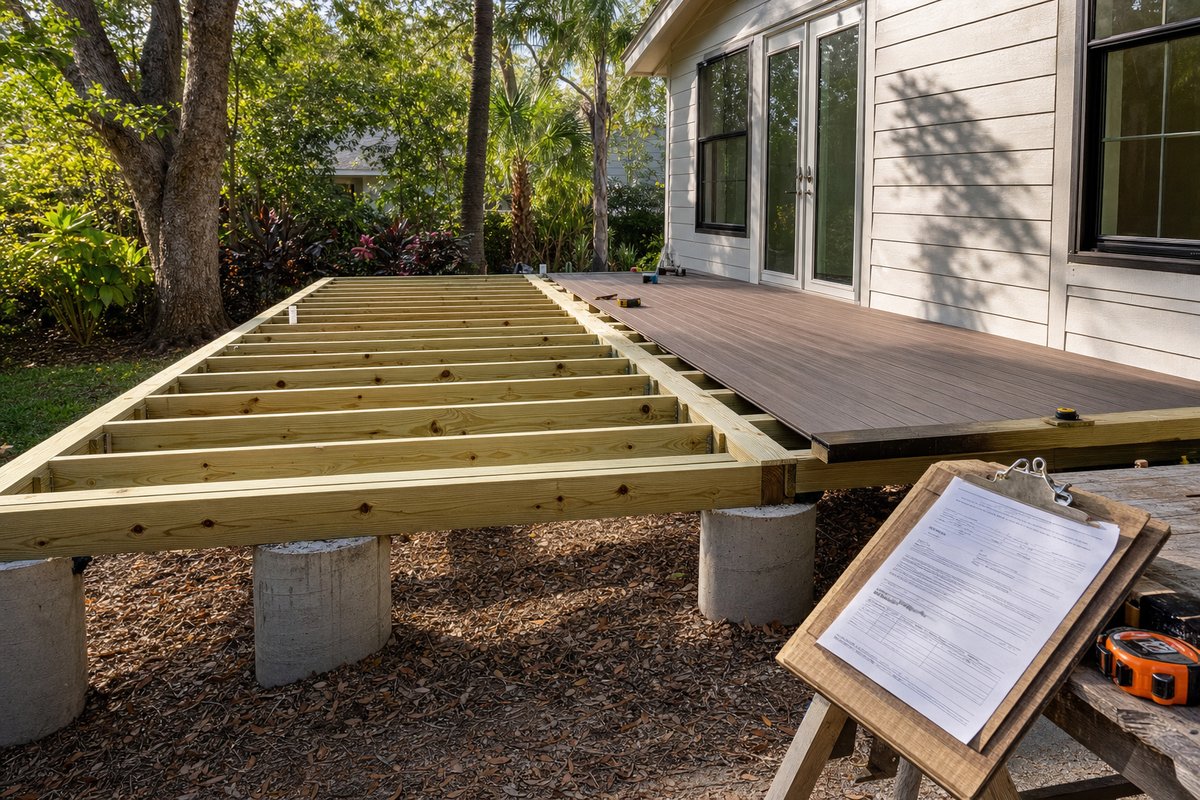
In most cases, yes. Building a new deck in Jacksonville (Duval County) almost always requires a permit from the City of Jacksonville before any work starts. A permit confirms your deck meets the Florida Building Code, including the 130-150 mph wind-load rules that matter in Northeast Florida. At Jacksonville Deck Builders, we pull the permit and handle inspections for you on every build.
- New decks and full deck replacements in Duval County require a building permit and pass through city inspections.
- Permitting reviews structural attachment, footings, and wind-load so the deck holds up in coastal storm conditions.
- Surrounding counties we serve (St. Johns, Nassau, Clay) each have their own permit office, so requirements vary by where you live.
Short answer: in most cases, yes. If your deck is attached to your home, sits more than a foot or two off the ground, covers much square footage, or includes electrical or plumbing, the City of Jacksonville expects you to pull a building permit first. A permit is not red tape for its own sake — it is how the city confirms your deck is built to hold weight, stand up to Florida storms, and stay safe for years.
The good news: you do not have to figure any of this out yourself. When we build your deck, we pull the permit and handle the inspections as part of the job. But it helps to understand how it works, so here is the plain-English version.
When a Deck Permit Is Required in Jacksonville
Permitting in Jacksonville is handled by Duval County through the City of Jacksonville. As a general rule, you need a permit when a deck:
- Is attached to your house in any way
- Stands more than 30 inches off the ground at any point
- Covers a larger footprint (bigger decks almost always need one)
- Includes electrical, plumbing, gas, or a roof structure — think lighting, an outdoor kitchen, or a covered porch
Even a freestanding deck that sits up high usually needs a permit. A tiny, low, ground-level platform may not — but the line is easy to misjudge, and guessing wrong is what gets homeowners in trouble. If you are not sure where your project lands, that is exactly the kind of thing we check for you before any work starts.
What About Setbacks?
A city permit is only one piece. There are also setback rules — how close your deck can sit to a property line. We file the county paperwork and confirm your project stays within those limits before any work starts.
Why Skipping the Permit Is a Costly Gamble
Plenty of folks are tempted to skip the permit to save a little time or money, or they hire a cheap crew that quietly builds without one. It almost always backfires. Here is what is actually on the line:
- Fines. The city can issue penalties for unpermitted work, and they can stack up while the problem sits unresolved.
- Forced removal or rebuild. If an inspector finds an unpermitted deck, you can be ordered to tear it out or open it up so it can be inspected after the fact — on your dime.
- Resale problems. When you sell, unpermitted work shows up. Buyers, their agents, and appraisers flag it. It can drop your price, scare off buyers, or stall the closing while you scramble to fix it.
- Insurance headaches. If someone is hurt on an unpermitted deck, or the deck fails in a storm, your insurer may push back on the claim.
A deck is one of the most-used parts of a Florida home. Permitting it correctly protects your money and the people who stand on it — and in a coastal market like Jacksonville, where decks face heat, humidity, and hurricane-force wind, that safety check matters even more.
Not sure whether your old deck is even permitted? That uncertainty is one of the most common reasons homeowners decide to replace rather than patch. We can walk your project and lay out your options at a free in-home estimate — no pressure, no obligation.
How Inspections Work
Once the permit is approved, the build is checked at a few stages instead of all at once. For a typical deck, that usually means:
- Footing inspection — before concrete is poured, to confirm the footings are deep and solid.
- Framing inspection — to confirm the structure, fasteners, and connectors meet code.
- Final inspection — once the deck is finished, to sign off that it is safe to use.
This is also where building the right way pays off. We engineer to Florida’s 130–150 mph wind codes using hurricane-rated metal connectors and concrete footings, so the deck is built to pass inspection and to hold up when the weather turns. The inspector is confirming what we already built in.
Repair vs. Replace — and Where We Fit In
A common question is whether an old, worn-out deck is worth saving. If the framing is rotted, the footings are failing, or it was never permitted in the first place, a full replacement is usually the smarter move — you get a sound, permitted, code-built deck instead of pouring money into a structure with hidden problems.
That is what we do. Jacksonville Deck Builders, a brand of Coastal Outdoor Construction, builds new decks and full replacements — we do not patch or refinish existing ones. We have been building since 2013, we are a Florida-licensed general contractor and fully insured, and we have built more than 500 decks across Jacksonville, Duval, St. Johns, Nassau, and Clay counties, with a 4.9-star rating on Google. When you hire us, pulling the permit and walking it through inspection is simply part of the job.
We build in materials suited to NE Florida: composite and PVC decking from Trex, MoistureShield, and AZEK, along with Ipe and cedar wood deck flooring. Adding a pool deck, pergola, or outdoor kitchen changes the permit scope. We handle the paperwork for the deck, pool deck or pergola we build; the trades who run gas, water and power pull their own.
The Bottom Line
For most Jacksonville decks, a permit is required — and getting it right protects you from fines, forced removal, insurance trouble, and resale surprises down the road. The simplest way to stay on the right side of it is to work with a licensed builder who does this every week.
If you are planning a new deck or replacing an old one, we will walk your project, explain exactly what your permit needs, and give you a clear estimate. Call us at (904) 944-9253 or request your free in-home estimate — we will take it from there, permit and all.