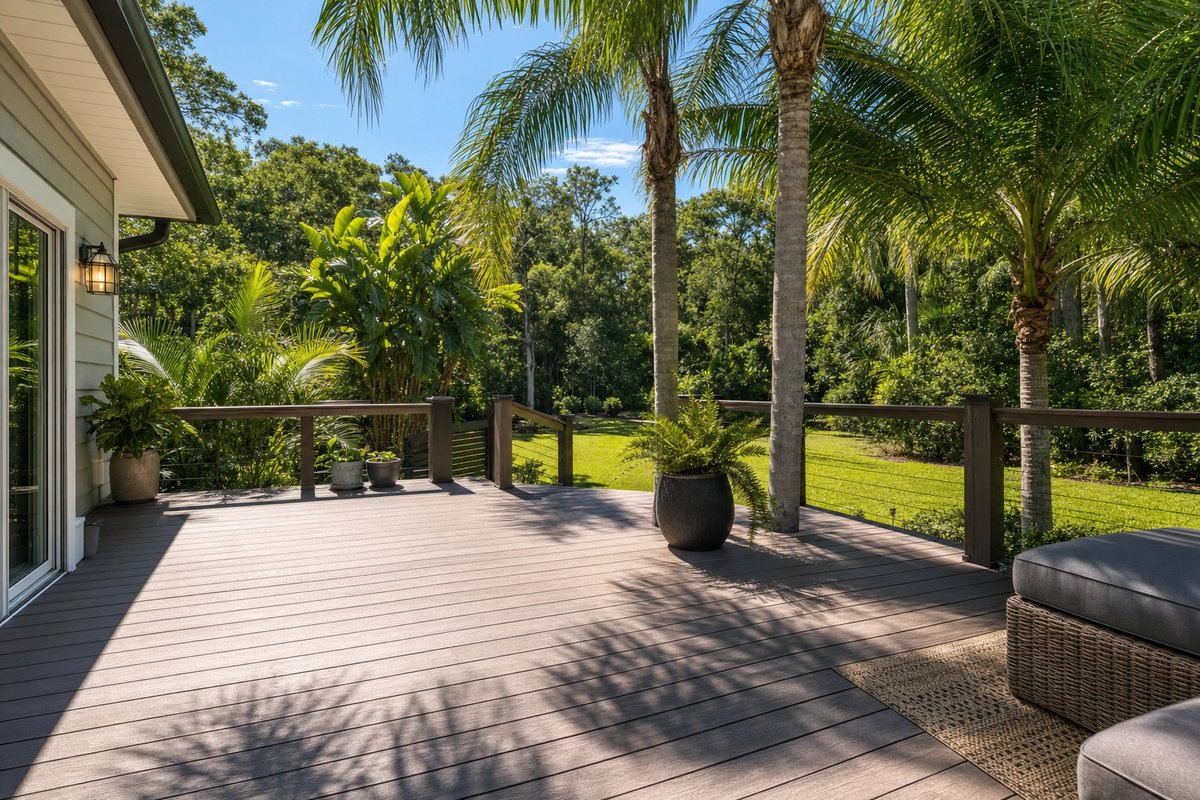
The thing nobody tells you about owning a deck in Northeast Florida: the weather, not the wood, decides how long it lasts. Relentless UV sun, salt-laden air near the coast, summer downpours, and 130-150 mph hurricane wind loads break down the wrong materials fast. The single most important decision is picking a material and a build that are made for this climate from day one, because Florida punishes shortcuts harder than almost anywhere in the country.
- Pressure-treated pine is cheapest at $20-30 per square foot installed, but Florida sun, humidity, and rain mean ongoing sealing and faster wear than coastal homeowners expect.
- Composite decking, including Trex and MoistureShield, runs $28-42 per square foot installed and holds up best to UV, moisture, and salt with the least upkeep, which is why it is the most popular choice across Duval, St. Johns, Nassau, and Clay counties.
- Florida Building Code requires decks to be engineered and permitted for 130-150 mph wind loads, so proper footings, framing, and fasteners matter as much as the surface boards.
Here is the honest version: a deck in Florida lives a hard life. The same heat, humidity, sun, and salt air that make our backyards so good ten months a year are the same things that beat a deck up. The good news is that none of it is a mystery. Pick the right material and build it right, and your deck lasts for decades with almost no work. Cut corners, and Florida finds them fast.
| Material | Installed cost (per sq ft) | Upkeep in FL | Holds up to sun & salt | Best for |
|---|---|---|---|---|
| Pressure-treated pine | $20-30 | High — regular sealing & cleaning | Fair | Budget builds, shaded yards |
| Composite (Trex & MoistureShield) | $28-42 | Low — wash-down only | Excellent | Coastal homes, low-maintenance owners |
| AZEK PVC & Ipe hardwood | $20-30 | Low to moderate | Excellent | Premium look at a competitive price |
| Pavers / aluminum | Priced by project | Low | Excellent | Ground-level patios, full-shade structures |
We have built decks in Jacksonville since 2013, across Duval, St. Johns, Nassau, and Clay counties. This is what we tell homeowners before they spend a dollar.
What Florida Weather Actually Does to a Deck
Most deck advice online is written for the rest of the country, where the enemy is freezing and thawing. Here it is something different almost every month, and it all adds up.
- Humidity and afternoon storms. The air is wet most of the year and we get a hard rain almost every summer afternoon. Wood soaks it up, swells, then dries and shrinks. Do that a few thousand times and boards cup, crack, and pull their screws loose. A deck has to be built to drain and dry, not trap water against the wood.
- UV and the sun. Our sun fades color, dries out wood, and breaks down cheap finishes in a couple of years. That is why a stained wood deck needs re-staining so often down here.
- Salt air near the coast. Near the water in Atlantic Beach, Jacksonville Beach, Ponte Vedra, or Amelia Island, salt eats regular screws and connectors from the inside out. Coastal decks need stainless steel screws and corrosion-resistant connectors, period.
- Bugs and mold. Termites love untreated wood. And any deck in our humidity grows a green film on the shady, damp spots if you ignore it.
The weather is not the problem. A deck built for some other climate is the problem. Build it for Florida and the weather stops mattering.
Why Material Choice Is the Whole Game
People obsess over deck size and shape. That matters, but the single biggest decision is the material. It decides how your deck looks in ten years, how much work it is, and how much you spend after the build.
Wood: lower cost up front, more work forever
Pressure-treated wood runs about $20 to $30 per square foot installed, and cedar about $20 to $30. It is the cheapest way to get a deck and can look beautiful, but in Florida wood is a commitment. It wants to be cleaned, sanded, and sealed on a schedule, and it weathers between coats. We also build with premium hardwoods like Ipe and cedar flooring for homeowners who want that look and know the upkeep. If you love real wood and do not mind the work, it is a fair choice. More on our wood deck page.
Composite and PVC: more up front, almost nothing after
This is what we steer most Florida homeowners toward, and it is not a sales line. Composite and PVC boards run about $28 to $42 per square foot installed. The tough outer shell means they do not rot, splinter, or feed termites, and they will not fade in our sun. You never sand, stain, or seal them, and humidity, salt air, and afternoon storms do not bother them the way they bother wood. We build with Trex, MoistureShield, and AZEK, and help you pick the right one at a free visit to your home. Full details on our composite decking page.
To put numbers on it: a basic 12x12 deck commonly runs between $2,900 and $6,000 depending on material. Wood lands at the low end, composite and PVC higher. But that gap closes fast once you add up years of stain, sealer, and work that wood needs and composite does not. If you are just figuring out what fits your budget, that is what our free in-home estimate is for.
What Upkeep Actually Looks Like
Owning a deck is not zero work, no matter what you build. But the gap between wood and composite is huge.
- Composite or PVC: A rinse with the hose now and then, plus a scrub with soap and water once or twice a year on the shady spots where mildew shows up. That is the whole list.
- Wood: A cleaning each year, plus sanding and re-staining or re-sealing every year or two in our sun. Watch for popped screws, soft spots, and splinters as it ages.
One honest note about heat: any deck in full Florida sun gets warm underfoot in the afternoon, and color matters more than brand. Lighter boards stay cooler than dark ones. If you are building around a pool, AZEK is worth a look because it runs about 30 degrees cooler underfoot than a dark composite. More on our pool deck page.
How It Is Built Matters Most
You can buy the best boards on the market and still end up with a bad deck if the structure underneath is wrong. This is where Florida is unforgiving, and it is the part you cannot see once the deck is done.
We engineer every deck to Florida wind codes, which run 130 to 150 mph depending on how close you are to the coast. That means hurricane-rated metal connectors at the key joints and concrete footings set deep enough to hold against a storm. We also pull the permit and get the plans stamped, which matters more than people realize: a permitted deck is covered by your Florida home insurance, and an unpermitted one usually is not. We are a Florida-licensed general contractor, fully insured, with an experienced in-house crew that has built more than 500 decks. We do new builds and full replacements, so if you have an old deck on its way out, we tear it down and remove it for free.
Repair or Replace?
Homeowners often ask whether to patch up an aging deck or start over. The honest rule: if the structure is sound and only a few boards are tired, patching can buy time. But if the framing is rotting, the connectors are rusted, or the deck was never built to code, you are throwing money at a problem that comes back. In Florida especially, a deck that was not built for the weather tends to fail all at once, not one board at a time. When that is where you are, a full replacement on the right material saves you money over the next ten years.
The Bottom Line
Owning a deck in Florida is genuinely worth it. Ours is one of the best climates in the country for outdoor living, and a good deck pays you back every weekend. The trick is to respect what the weather does: pick a material that shrugs off humidity, sun, salt, and bugs, and build it to code with the right hardware and footings.
If you want a straight, honest opinion on what makes sense for your yard and your budget, that is what we do. Get a free in-home estimate, or call us at (904) 944-9253. We will give you a real number and tell you the truth about what holds up here. No pressure either way.