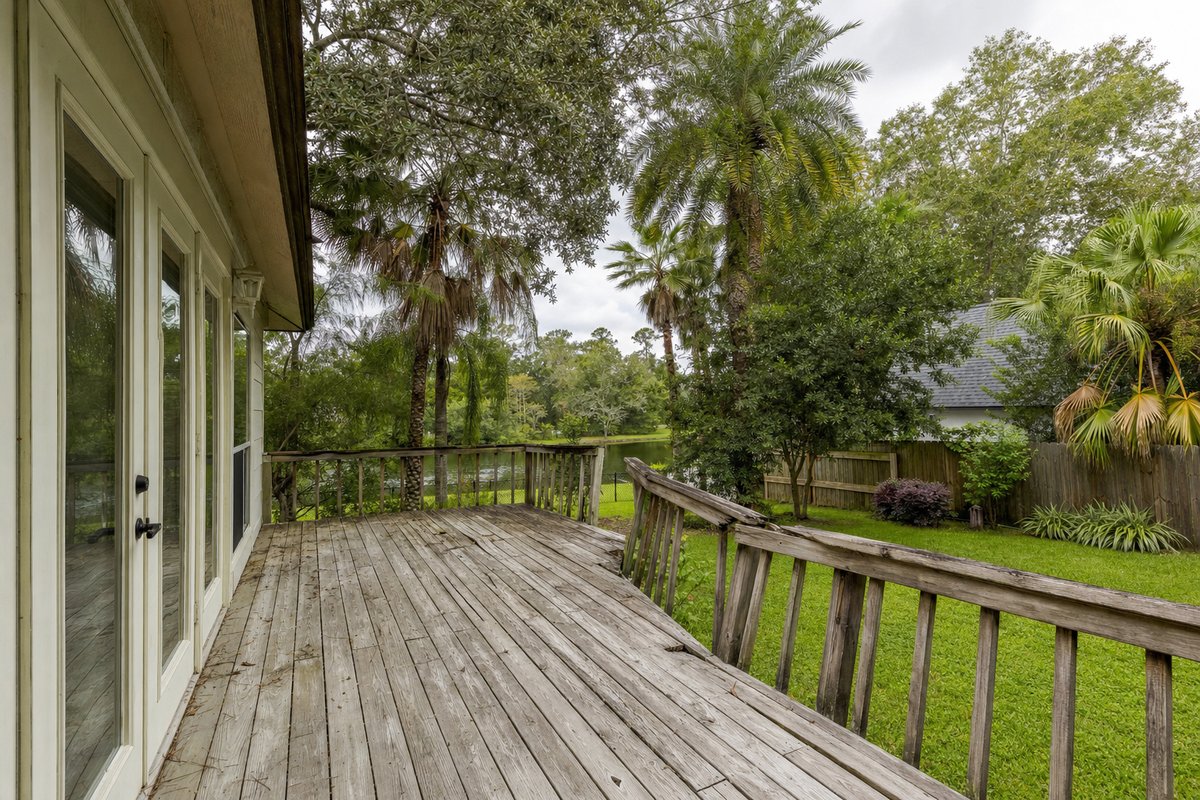
The clearest sign it is time to replace your deck in Jacksonville is soft, spongy, or rotting wood in the framing or support posts. In NE Florida's heat, humidity, and salt air, structural decay is the point where repairs no longer pay off and a full replacement is the safer, smarter move. If a screwdriver sinks into a joist, post, or ledger board, the deck has reached the end of its life.
- Watch for wobbly railings, loose or pulling-away ledger boards, and posts that move when pushed — these are safety failures, not cosmetic ones.
- Florida wind code requires decks to handle 130-150 mph; an older deck not built or fastened to that standard should be replaced rather than patched.
- Widespread rot, rusted hardware, or a deck older than 15-20 years usually costs more to keep fixing than to rebuild new.
The short answer: if your deck has spreading rot, soft or spongy boards, rusted or failing fasteners, or a frame that sags or wobbles, it is time to replace it, not patch it. A few cosmetic cracks or a faded board do not mean your deck is done. But once the damage reaches the structure, the safe move is a new build.
We are Jacksonville Deck Builders, a brand of Coastal Outdoor Construction, building across Duval, St. Johns, Nassau, and Clay counties since 2013. We build new decks and full replacements — not patch jobs. Below are the signs we look for, written plain so you can check your own deck this weekend.
Why Florida is hard on decks
Northeast Florida throws everything at a deck: heavy humidity, hard rain, intense sun, and salt air near the coast. That mix speeds up rot, rusts metal fasteners, and cracks boards faster than in drier states. So if your deck is showing its age, you are not imagining it. The real question is whether the damage is surface-level or structural.
Clear signs it is time to replace your deck
1. Rot you can see or smell
Rot is the big one. Look for dark, discolored patches, a musty smell, or wood that flakes and crumbles. Press a screwdriver into the boards, the joists underneath, and the ledger board where the deck attaches to your house. If the tool sinks in easily, that wood is rotted through. Spot rot can sometimes be contained, but once it spreads into the frame or the ledger, the deck is no longer safe and needs to be replaced.
2. Soft or spongy boards
Walk your deck barefoot. If a board feels soft, springy, or bouncy underfoot, the wood has broken down inside even if it looks okay on top. A soft board or two in one spot is one thing. Soft spots across the deck mean the material is failing and a full replacement is the honest fix.
3. Wobbly or loose railings
Grab your railing and give it a firm push. It should not move. A wobbly rail is a real safety risk — it is the thing standing between a person and a fall. Loose rails often point to rot or rusted fasteners where the posts meet the frame, which means the rail is a symptom of a bigger problem.
4. Rusted or failing fasteners
Look at the screws, nails, bolts, and metal brackets. Rust streaks, popped nails, or connectors flaking apart are warning signs. In Florida humidity and salt air, the wrong fasteners corrode fast, and when the hardware holding a deck together fails, the whole deck loses strength even if the boards still look fine.
5. A frame that sags, leans, or shifts
Stand back and look at the whole deck. Does it dip in the middle, lean to one side, or has it pulled away from the house? Any of that points to a structural problem with the joists, beams, posts, or footings. This is the most serious sign on the list. A sagging or shifting frame is not a repair — it is a deck that needs to come down and be rebuilt right.
6. You keep fixing the same things
If you are patching boards and chasing soft spots year after year, the deck is telling you something. At some point the money and weekends spent keeping an old deck limping along are better put toward a new one that is safe and basically maintenance-free.
Not sure if your deck has crossed that line? We will take an honest look during a free in-home estimate and tell you straight — no pressure. Get your free quote or call (904) 944-9253.
When you probably do not need to replace yet
We will be honest: not every worn deck needs to come down. Some issues are cosmetic, and your deck may still have good years left if the structure is sound. You likely do not need a full replacement yet if you are only seeing:
- Surface gray or fading from the sun, with solid boards underneath
- A few small surface cracks or splinters in otherwise firm wood
- Dirt, mildew, or stains that are just sitting on top
- One or two loose screws on an otherwise solid, sturdy frame
If that is all you have got, your deck may simply be aging on the surface. The key test is always the structure: press for soft spots, check the joists and ledger, push on the rails, and look for sag. As long as the bones are solid, you may have time. The moment those checks turn up rot, soft framing, or movement, replacement becomes the safe choice.
Why replacement beats limping an old deck along
When a deck has reached the end of its life, a new build is usually the better value, because it lets you start clean with the right materials and a frame engineered to last. We build with low-maintenance composite and PVC from Trex, MoistureShield, and AZEK, and hardwood flooring like Ipe and cedar for a natural look. Composite runs about $28 to $42 per square foot installed, pressure-treated wood about $20 to $30, and cedar about $20 to $30, so a 12x12 deck commonly runs about $2,900 to $6,000 depending on the material. If summer heat is a concern, AZEK runs about 30 degrees cooler underfoot than dark composite.
Just as important is what holds it up. We engineer every deck to Florida 130 to 150 mph wind codes with hurricane-rated metal connectors and concrete footings — the part you cannot see, and the part that matters most when the old one failed. A replacement is also the time to rethink the space, whether that means adding a pergola for shade, a covered porch, or an outdoor kitchen.
How we handle a deck replacement
Our experienced in-house crew handles it start to finish, beginning with a free in-home estimate where we inspect the old deck, talk through materials, and give you an estimate. The old-deck demolition and removal is included in your estimate, then we build your new deck to code and clean up when we are done.
We are an FL-licensed general contractor, fully insured, with 500+ decks built and a 4.9-star rating on Google. To weigh your options first, our guide on composite vs. wood decks in Jacksonville breaks down cost and upkeep, and our piece on owning a deck in Florida covers what our climate really does to one over time.
If your deck is showing the signs above, do not wait for someone to get hurt. Get an honest read on it. Compare your composite decking and wood deck options, then build with a crew that does it right the first time. Call (904) 944-9253 or request your free quote.