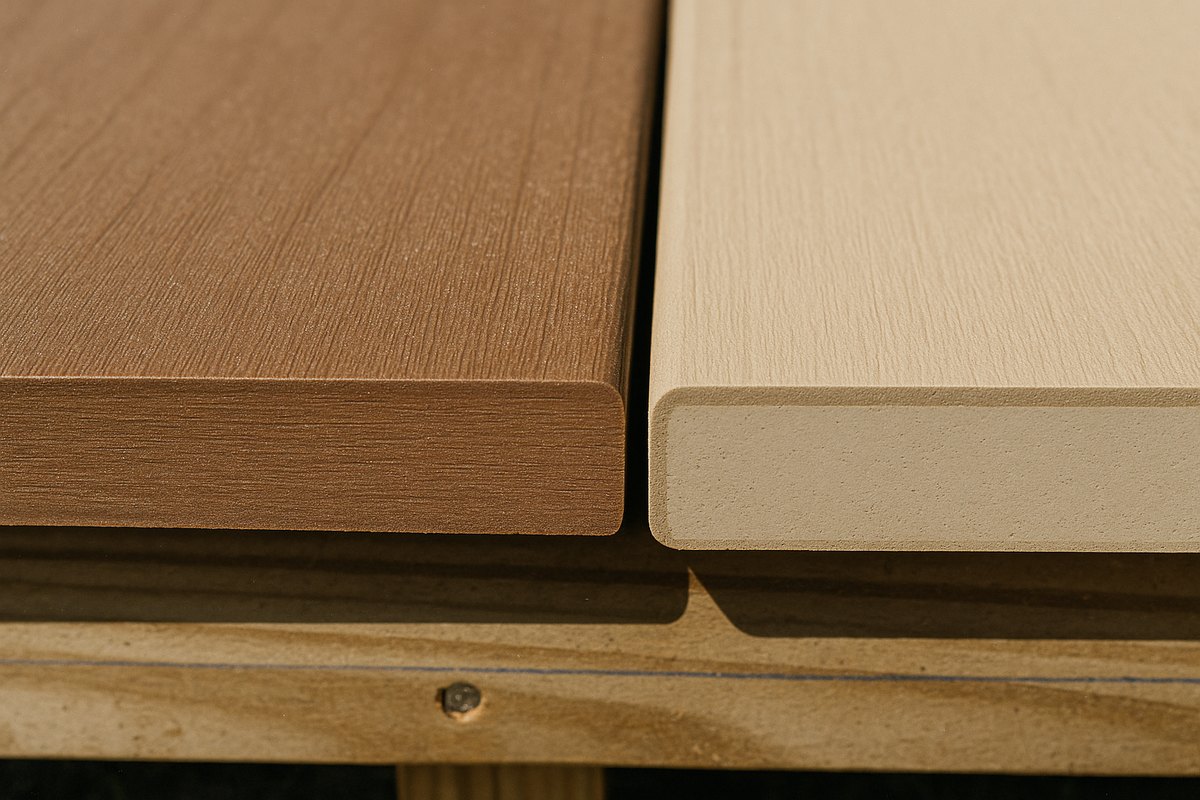
Capped composite is wood fibre and plastic under a protective shell. It is heavy, stiff and excellent on a covered or shaded deck. Solid PVC has no wood in it at all, so it runs cooler, weighs less and cannot wick water into its core, which makes it the stronger choice for full sun and wet areas like a pool surround. PVC moves more with temperature, so it asks more of the installer. Choose by sun and water first, then by look.
From a sample table, a capped composite board and a PVC board look like two versions of the same thing. Same size, similar grain, similar colours, and both promise no staining and no rot.
Build a deck with each and they stop looking alike. They weigh differently, they react to heat differently, they handle water differently, and they move differently through a Florida summer. Those differences show up in how the deck is framed, gapped and fastened, and in how it feels on a July afternoon.
This is the build side of that decision: what each material actually is, and what changes when we put it down.
The short version. Capped composite is wood fibre and plastic under a protective shell. It is heavy, stiff and excellent on a covered or shaded deck. Solid PVC has no wood in it at all, so it runs cooler, weighs less and cannot wick water into its core, which makes it the stronger choice for full sun and wet areas like a pool surround. PVC moves more with temperature, so it asks more of the installer. Choose by sun and water first, then by look.
What each board is actually made of
Capped composite is a blend of wood flour and plastic, wrapped in a hard polymer cap. The core gives the board its weight and stiffness. The cap does the protective work, blocking sun, resisting stains and keeping water out of the core.
Solid PVC is cellular PVC all the way through, with no wood content at all. It is usually capped too, but the core underneath is the same material as the surface, so there is nothing organic inside to absorb water or hold heat.
That single difference, wood fibre or no wood fibre, drives almost everything else in this article.
| Capped composite | Solid PVC | |
|---|---|---|
| Core | Wood flour and plastic | Cellular PVC, no wood |
| Heat in full sun | Warms up much like wood | Runs noticeably cooler |
| Weight | Heavier, stiffer | Lighter |
| Water at cut ends | Core can absorb it | Nothing to absorb it |
| Thermal movement | Moderate | Greater, so gapping matters more |
| Best fit | Covered or shaded decks | Full sun and wet areas |
Heat, which is the question everyone asks here
A board heats up because it absorbs solar energy and holds on to it. The wood fibre core in a composite board does exactly that, so standard composite in open sun warms up roughly the way wood does.
Solid PVC has no wood fibre to soak up that energy, and that is why it runs cooler. On full sun decks we point people toward AZEK PVC, which our own spec puts at roughly 30 degrees cooler underfoot than wood or standard composite in direct Florida sun. Treat that as a full sun comparison, not a fixed number, because colour, sun angle and airflow all move it.
Colour matters almost as much as material. Light greys and tans stay noticeably cooler than dark browns in either category. And no board deck is genuinely cool barefoot at two in the afternoon in July, so on an open, west facing deck the real answer is a light board plus some shade. We bring samples out so you can put your hand on a hot board before you decide.
Water, and why the cut ends matter
The cap on a composite board does a very good job of keeping rain and splash out. The weak points are anywhere the cap is not: cut ends, notches around posts and any spot where the surface has been damaged.
At those points the wood fibre core is exposed, and it can take on water. On a deck that dries out between storms, that rarely matters. On a deck that stays damp, sits low over wet ground or takes constant splash, it matters a great deal, and it is one reason composite decks can struggle from the underside in the wrong conditions. We wrote about that failure pattern in why Jacksonville decks rot from the bottom up.
PVC does not have this problem. A cut end is the same material as the face, with nothing inside to absorb water. Around a pool, next to irrigation or on a low deck, that is a real advantage.
Movement, the part that asks more of the installer
Every decking material expands and contracts with temperature. PVC moves more than composite does.
That is not a defect, but it changes how the deck has to be built. Gaps between boards and at the ends of boards have to follow the manufacturer's requirements for the temperature on the day of installation. Long runs need a plan for where the movement goes, which is often a picture frame border or a deliberately placed break. And the fastening has to let the board move rather than pin it rigidly in place.
Get that right and the movement is invisible. Get it wrong and the deck shows it in its first summer, with gaps opening unevenly, ends pushing against each other or boards pulling at their fasteners. That is why hidden fastener systems are standard on the composite and PVC decks we build.
Weight and stiffness
Composite is the heavier and stiffer of the two, which gives it a solid feel underfoot. PVC is lighter, which makes it easier to handle during a build and puts less load on the structure.
Both materials have their own joist spacing requirements, and they are not interchangeable between product lines. Diagonal or herringbone board layouts usually need closer joist spacing than straight runs. None of that is a reason to pick one material over the other, but it is a reason the framing plan has to be drawn for the specific board you choose, not for decking in general.
What does not change: the structure underneath
Whichever board goes on top, the deck lives or dies on what holds it up.
Our framing goes in pressure treated to ground contact rating, with hurricane rated metal connectors throughout, meaning joist hangers, post bases, post caps and hurricane ties, over concrete footings sized for uplift in local soil, built to the wind rating our area requires. Near the coast and around pools, fasteners and connectors are marine grade stainless, because salt and chlorine attack ordinary hardware long before they bother the boards.
A premium PVC surface on a poorly built frame is still a poorly built deck. The board warranty covers the boards, not the structure beneath them.
Where each one belongs
- Full sun deck you want to walk barefoot: solid PVC, in a light colour.
- Covered, screened or shaded deck: capped composite, which is excellent value where heat is not the issue.
- Pool surround in full sun: solid PVC, for heat and for splash. Our guide to the best pool deck materials goes into that in detail.
- Low deck close to damp ground: PVC, or a composite line specifically rated for ground contact.
Plenty of decks end up as a mix: PVC on the sunny, wet end near the pool and composite on the covered section by the house. There is nothing wrong with that, as long as the two are chosen to sit together visually. See the range on our composite decking page.
One more thing before you plan. Jacksonville Deck Builders focuses on new builds and full deck replacement rather than repairs or resurfacing. If your current deck is failing, we will walk you honestly through repair versus replacement at the consult, and when replacement is the right call we remove the old structure before building the new one to current Florida code.